






Build AI that drives decisions you trust.
Trusted AI / Framework
The five-pillar framework for AI that acts with confidence and accountability.
The AI trust gap
AI agents are routing pipeline, generating revenue forecasts, triggering customer communications, and automating go-to-market decisions at a scale and speed no human team can match.
The AI is acting. Can you trust what it’s acting on?
A human analyst who gets a number wrong can be questioned, corrected, and held accountable. An AI agent that routes a thousand leads based on a misconfigured semantic layer scales the error silently across your entire pipeline before anyone notices.
This is the AI trust gap: the growing distance between what AI is doing and what your leaders can verify, explain, or defend.
Meanwhile, 80% of organizations have already encountered risky or inaccurate behavior from AI agents, according to McKinsey - and in most cases, they only found out after the fact.
Deploying more automation into a system that already produces outputs people can’t verify doesn’t solve the trust problem. It compounds it.
This isn’t a technology or AI model problem. The models are capable. Most organizations deploying AI have capable systems. The problem is structural: the data beneath the model is ungoverned, the model doesn’t understand your business, and the reasoning it uses is invisible.
The answer isn’t to slow down. It’s to build the trust architecture and foundation that makes AI automation defensible: Trusted AI.
What Trusted AI actually is
Trusted AI is an enterprise decision system. It’s an architecture built on governed data, explicit business semantics, transparent causal reasoning, and structured human oversight - so every automated decision your organization makes is one you can verify, explain, and defend.
Most AI deployments in the enterprise are point solutions: a model trained on available data, producing outputs that may or may not connect to how your business actually operates. When the output is wrong, or when the decision gets questioned, there’s no trail to follow. No way to show why the recommendation was made, what it was grounded in, or what the confidence level was.
Trusted AI can. Every insight it produces comes with step-by-step reasoning, a confidence score, and a traceable causal chain - from input data to business outcome.
The practical result: automated decisions your organization can stand behind. Teams aligned on a shared view of performance. Forecasts that leadership and PE sponsors can act on. AI outputs that survive board-level scrutiny.
That’s the difference between having AI and having Trusted AI.
See where your organization stands.
Take the AssessmentThe five pillars of the Trusted AI framework
Trusted AI is built on five interdependent pillars. Each one addresses a specific failure mode in the way most enterprises currently deploy AI. Implementing some without others is how AI governance projects fail.

Pillar 1: Trusted data foundation
No other pillar works without this one.
A trusted data foundation means your data is audited, integrated, complete, current, and traceable. Every metric has a single, canonical definition that all teams use. Every data point has a clear source, owner, and lineage.
AI data foundation done right produces a single source of truth. Without it, every downstream pillar is building on a foundation that can’t be trusted.
The tell that your data isn’t governed: two teams in the same company produce different versions of the same metric. Revenue is the most common. Win rate is another. When that happens, every AI output built on that data inherits the conflict.

Pillar 2: Transparent reasoning
Every trusted insight is built the same way: scoped input context, data mapped to your canonical definitions, results decomposed into rate, volume, and mix effects, statistical validation to rule out noise, reasoning over a persistent knowledge graph of your business, recommendations tied to levers you can pull, and a confidence score on the output.
Causal decomposition is where most AI stops short. “Revenue declined 8% in Q3” is a data point. “Revenue declined 8% because of a 12% volume contraction in SMB, driven by a 3-week lag in pipeline coverage after the May pricing change” is a decision. Correlation tells you two things moved together, not which caused the other.
This is the pillar that matters most under scrutiny. A CFO or PE sponsor doesn’t need to trust the model, they need to interrogate it: challenge an assumption, get a revised output, see whether it holds. Black boxes don’t survive board scrutiny.

Pillar 3: Human oversight
Material decisions require human sign-off. Overrides are logged with documented justification. A cross-functional governance board maintains accountability for how the AI is deployed and how its automated outputs get used. Ethical review and bias audits run on a regular cadence.
The gates belong at specific points, not everywhere: forecasting, pipeline and SDR allocation, pricing changes, budgeting, and any material reallocation of marketing spend. Logic checkpoints require approval before a recommendation becomes an action. Context injection lets a leader override the model for something it cannot know — a pending regulation, a competitor merger.
This is an AI governance framework, not a brake on the system. The AI proposes; leadership decides. That separation is where ROI gets generated, and where trust in automation builds instead of collapsing the moment something can’t be explained.

Pillar 4: Secure architecture
Security is a prerequisite, not a feature.
Weak security doesn’t just risk a breach. It undermines confidence in every recommendation the system produces. A platform that can quietly send customer records or proprietary logic to an uncontrolled endpoint won’t get board approval, however good its answers are.
Five controls make it secure by design: single-tenant environments in your own Snowflake, Databricks, or private cloud, with no cross-tenant commingling; no public internet exposure, so no prompt or model interaction touches a public LLM endpoint; end-to-end encryption at rest and in transit; role-based access controls with every access point auditable; and full audit logging of every inference, prompt, and dashboard view.
That closes three risks: regulatory exposure of PII or financial records under GDPR, CCPA, and SOX; intellectual property loss to external model training; and sensitive data reaching third-party plugins or APIs that never passed a governance review. Your proprietary model stays yours alone.

Pillar 5: Continuous validation
Trust is not built once and left alone.
A well-built system degrades without maintenance. Data drifts. Business models change. New products, markets, and org structures force the semantic layer to evolve. A framework built at one point in time is out of date the moment the business moves.
Continuous validation keeps it honest. Drift monitoring flags when input distributions no longer match what the system was calibrated against. Concept drift detection catches the harder case, where the data looks normal but conversion dynamics changed underneath it. Bias and integrity checks validate accuracy across cohorts, channels, and time. Anything detected triggers a defined path: reconciliation, retuning, rule updates, or a governance session to realign definitions.
Above that sit quarterly trust reviews and a real-time trust dashboard showing drift alerts, reliability scores, and override rates. Governance without validation is theater. Validation without governance is technical debt. Keeping both current is what G2M’s Trust Operations Model is built for.
Why generic AI fails at the point of decision
Not hallucinating isn’t a high enough bar. The enterprise standard is harder: can a leader act on this output with confidence, trace the reasoning behind it, and defend the decision to a board or sponsor? Most AI tools fail that test.
Generic AI – including most large language model deployments and analytics copilots – fails this standard for three structural reasons:It doesn’t know your business. Without a semantic layer, a model can’t encode your funnel definitions, attribution logic, or territory rules. It processes data, not business context. Every output it produces is one bad assumption away from being wrong in a way you can’t detect until it’s too late.
It correlates rather than causes. Correlation-based AI identifies patterns. It can tell you that revenue declined when sales cycle length increased. It can’t tell you which one caused the other – or whether both were driven by a third factor you’re not measuring.
It has no governance trail. When the CFO asks “how did you get this number?”, a black-box model has no answer. In high-stakes environments – PE-backed companies, regulated industries, public boards – AI outputs that can’t be traced back to their logic and source data are organizational liabilities.
The five pillars close all three gaps.
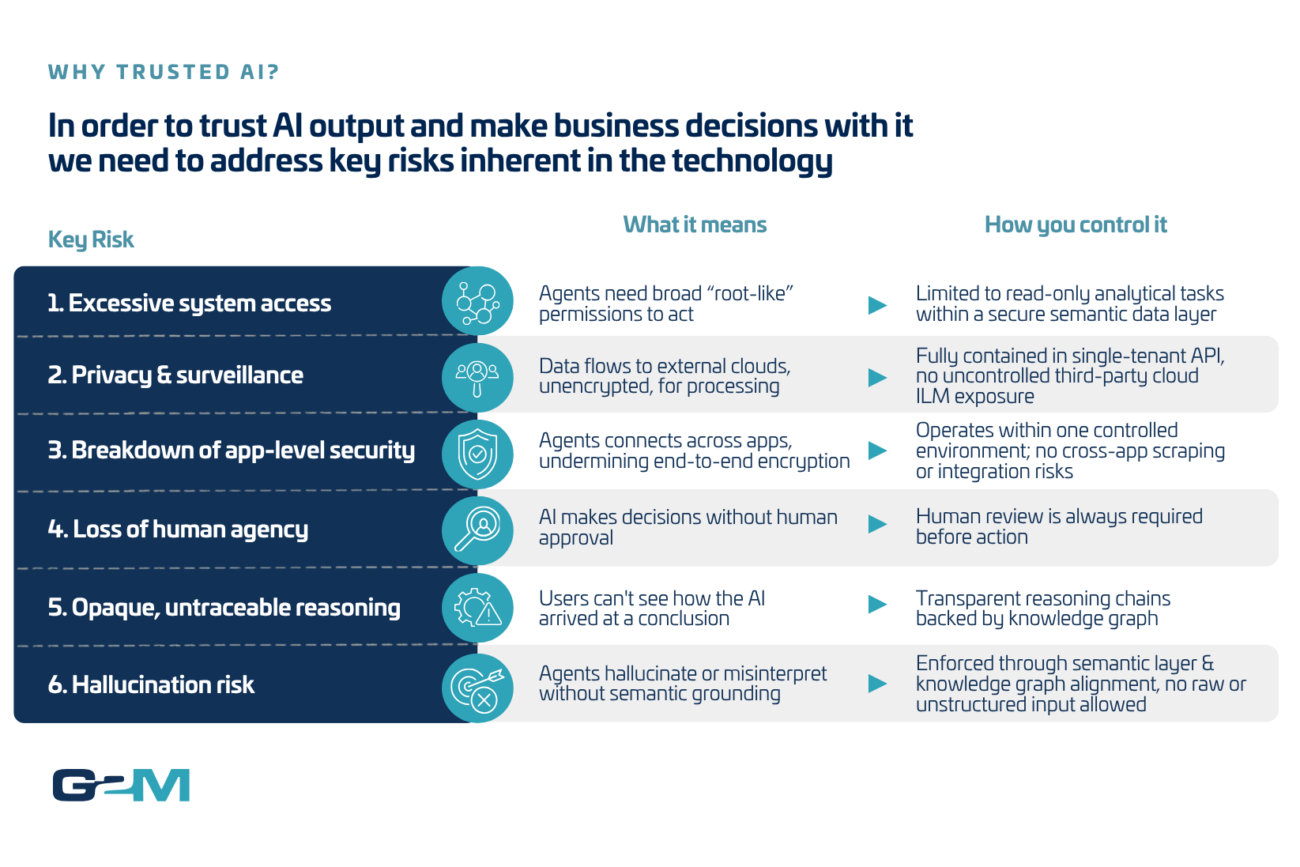
Those three structural failures don’t stay theoretical. At scale, and especially in agentic architectures where agents are making decisions autonomously across your pipeline, they compound.
An ungoverned model without a semantic layer or causal reasoning – acting autonomously at volume – introduces six specific risks: Learn more about the six risks of AI and how to control for each risk.
Where does your organization stand?
Most organizations are further from Trusted AI than they believe.
The gap isn’t usually in the technology. It’s in the governance, data, and semantic infrastructure that makes AI outputs defensible.
Drexel University research makes this concrete: 87% of organizations claim they are AI-ready, yet 42% cite infrastructure limitations as a primary barrier to deployment. The gap between perceived and actual readiness is where most AI governance failures begin.
G2M’s Trusted AI Readiness Assessment evaluates your organization across eight domains:
- Data foundation and quality – unified GTM data, canonical metric definitions, data lineage, freshness alignment
- Semantic layer and business understanding – canonical KPI definitions, encoded business model, standardized time windows and hierarchies, explicit business rules
- Explainability and reasoning transparency – reasoning chain generation, explicit causal attribution, confidence scores, auditable outputs
- Human oversight and governance – mandated human approval, logged override mechanisms, active governance board, documented ownership
- Security and access control – single-tenant deployment, end-to-end encryption, governed API pathways, cross-tenant data isolation
- Continuous validation and monitoring – automated drift detection, regular bias checks, quarterly backtesting, real-time KPI accuracy monitoring
- Cross-functional alignment – shared metric definitions, unified executive narrative, single dataset powering all reporting, mapped cross-functional workstreams
- Deployment, adoption, and change management – team understanding of AI’s role in decisions, integration into executive workflows, formalized feedback loops, role-specific training
The assessment is an AI governance audit across all eight domains. It shows exactly where your architecture is sound and where the gaps are that a board member, PE sponsor, or external auditor could expose. Most assessments surface two or three critical gaps that explain why the AI tools and agents already in place aren’t generating the decision confidence leadership needs.
Get the complete methodology.
Download the Trusted AI Executive GuideThe Trusted AI Maturity Model
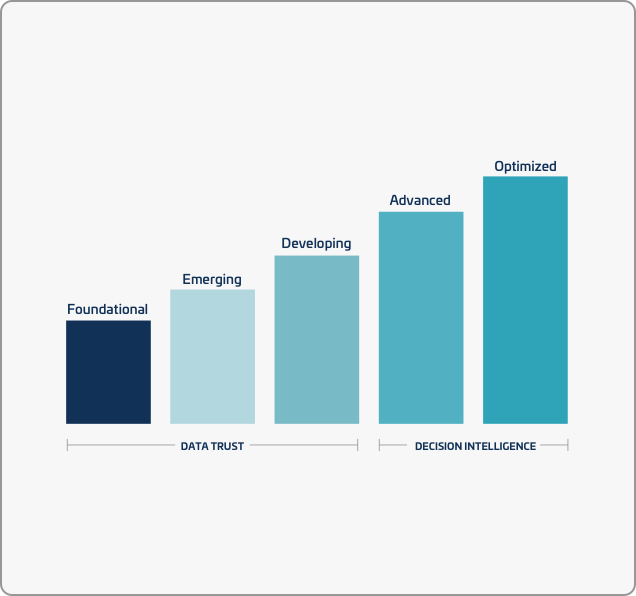
The Trusted AI maturity model maps organizations across five stages, and most enterprises entering the assessment land at Stage 1 or Stage 2, regardless of how long they’ve been deploying AI tools.
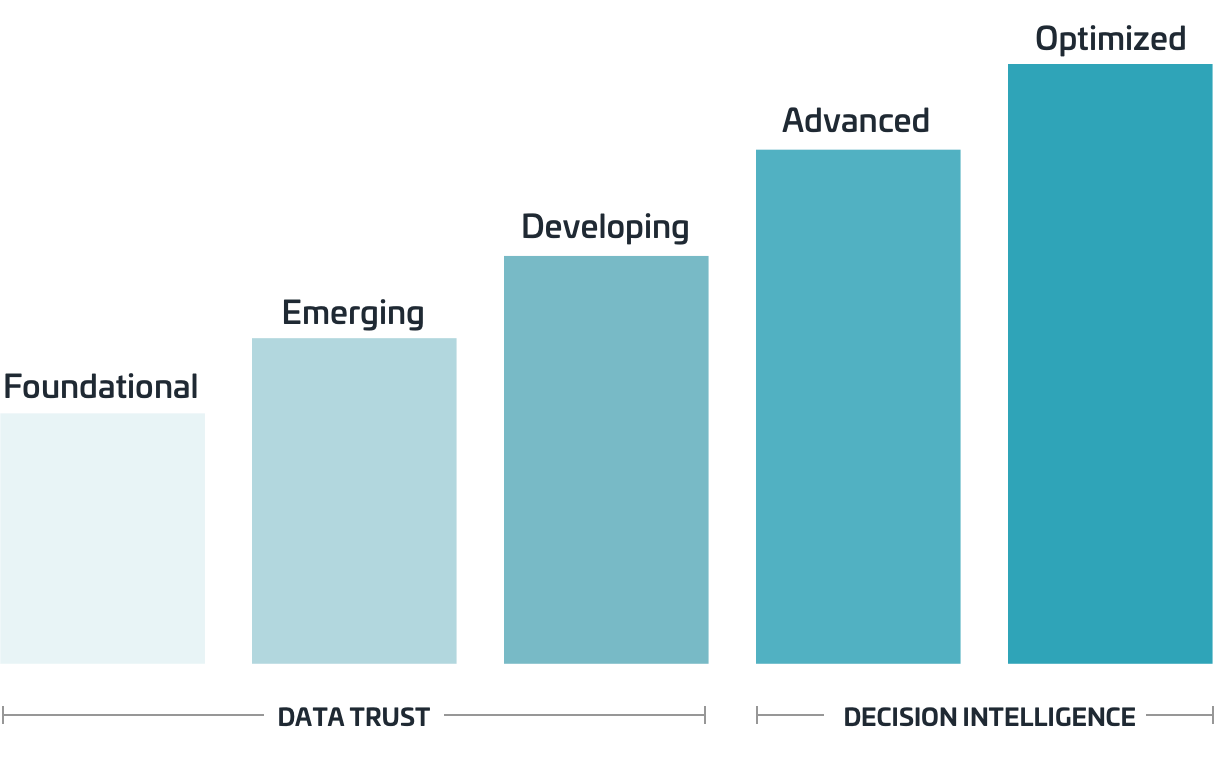
Stage 01
Foundational
Fragmented data with conflicting definitions across functions. Manual, slow explanations for AI outputs. Low organizational trust in AI recommendations. Dashboards don’t align across teams.
Stage 02
Emerging
Partial data unification is underway. Early consistent metric definitions are in place for some functions. AI experimentation is active but isolated. Insights are lagging and inconsistent. Teams are beginning to align on a shared data narrative but haven’t achieved it.
Stage 03
Developing
Data is mostly unified. Shared, clearer definitions are in place. AI grounded in governed data is improving output reliability. Performance reporting is reaching granular breakouts. Cross-functional narrative alignment is improving. Early proactive insights are appearing.
Stage 04
Advanced
Fully unified GTM data with a mature semantic layer in place. Trusted AI with causal explanations is available in minutes, not days. Recommendations are reliable and consistently actioned. High alignment across Sales, Marketing, Finance, and Operations.
Stage 05
Optimized
Predictive and scenario-based AI is embedded in strategic decisions. AI outputs are fully trusted, auditable, and explainable on demand. Automated detection and proactive recommendations are operating continuously. Decision loops are fully instrumented.
Take the Trusted AI Assessment
Get a clear picture of your architecture - where it’s sound and where the gaps are.
Take the AssessmentBuilt by operators, for operators
G2M’s AI consulting practice spans telecom, technology, private equity, manufacturing, and hospitality. Clients range from emerging growth companies to global enterprises.
- 5.5x improvement in conversion rates for high-propensity prospects
- Decision cycles reduced from weeks to hours after deployment
- Forecast accuracy improved to 85%+ from baselines in the 70% range
- 15–25% of analytics team capacity recovered from metric reconciliation
G2M is an Inc. 5000 honoree and Denver Fast 50 winner in 2024 and 2025. The firm was founded by operators who have built and scaled revenue organizations – not by technologists selling software.
Go deeper on Trusted AI
The latest thinking from G2M’s practice, organized by the topics that matter most to enterprise AI leaders.
Shadow AI is an unvetted contractor already working inside your business
Read PostMCP servers give agents the keys to your systems. Who’s governing the door?
Read PostPrivate AI: Your Strategy Doesn’t Belong in Someone Else’s Context Window
Read PostIf you haven’t hit an AI trust issue yet, you’re still in the honeymoon phase
Read PostHow telecom operators build the data foundation for hyper-local subscriber growth
Read PostFrequently asked questions
-
Responsible AI is a set of principles: fairness, transparency, accountability, non-maleficence. It defines what AI governance should achieve.
Trusted AI is an operational architecture: the specific systems, structures, and processes that make responsible AI real inside an enterprise. It’s not a policy. It’s a capability.
Responsible AI without an operational architecture is a governance policy that exists on paper. Trusted AI is the architecture that puts that policy into practice.
-
Explainable AI (XAI) focuses on making an individual model’s outputs interpretable – showing which inputs drove a specific prediction or classification. It’s a feature of certain model architectures.
Trusted AI addresses a broader question: can the organization act on this output with confidence?
That requires explainability, but also governed data underneath the model, a semantic layer that connects the model’s outputs to your business logic, causal attribution rather than correlation, and governance infrastructure that creates accountability for every automated decision.
-
The five pillars address five distinct failure modes in the way most enterprises currently deploy AI:
1. Trusted data foundation: unified pipelines, a semantic layer, and your business model encoded into the system, so every metric has one canonical definition and the AI reasons in the real economics of your business. Delivers truth.
2. Transparent reasoning: a structured, auditable chain from input context through causal decomposition, statistical validation, and confidence scoring. The model shows its work and leaders can interrogate it. Delivers clarity.
3. Human oversight: material decisions require human sign-off, overrides are logged with justification, and a cross-functional governance board maintains accountability. The AI recommends; leadership decides. Delivers control.
4. Secure architecture: single-tenant deployment, no public internet exposure, end-to-end encryption, role-based access controls, and complete audit logs. Your data never trains someone else’s model. Delivers safety.
5. Continuous validation: drift detection, bias monitoring, recalibration, quarterly trust reviews, and a real-time trust dashboard, so the system adapts as the business changes. Delivers sustainability.All five are interdependent. Implementing some without others is how AI governance projects fail.
-
Three structural reasons, and they apply to most enterprise AI deployments regardless of the tools or platforms involved:
- No semantic layer. The AI doesn’t know what your data means inside your business. It can route pipeline without understanding your qualification criteria, or generate forecasts without encoding your attribution logic.
- Correlation, not causation. Most AI systems identify statistical patterns. They can tell you that two things moved together. They can’t tell you which one caused the other – and in high-stakes decisions, that distinction determines whether the action you take fixes the problem or accelerates it.
- No governance trail. When the CFO asks how the number was produced, a black-box model has no answer. AI outputs that can’t be traced back to their reasoning become liabilities in any environment where decisions are scrutinized.
The five pillars are designed to close all three gaps specifically.
-
The assessment is an AI governance audit across eight domains:
- Data foundation and quality: unified GTM data, canonical metric definitions, data lineage, freshness alignment
- Semantic layer and business understanding: encoded business model, standardized KPI definitions, explicit business rules
- Explainability and reasoning transparency: reasoning chain generation, causal attribution, confidence scores, auditable outputs
- Human oversight and governance: mandated human approval, logged overrides, active governance board, documented ownership
- Security and access control: single-tenant deployment, encryption, governed API pathways, cross-tenant isolation
- Continuous validation and monitoring: automated drift detection, bias checks, quarterly backtesting, real-time KPI accuracy monitoring
- Cross-functional alignment & communication: shared metric definitions, unified executive narrative, single dataset powering all reporting
- Deployment, adoption, and change management: team understanding of AI’s role in decisions, formalized feedback loops, role-specific training
Most organizations that go through the assessment surface two or three critical gaps that explain why existing AI tools aren’t generating the decision confidence leadership needs.
-
An AI tool produces outputs. An analytics platform displays data. Neither governs what your organization does with those outputs, nor creates accountability for the decisions that follow.
The difference becomes clear under pressure. When a forecast turns out to be wrong, an AI tool can’t show you why. When the board asks how the recommendation was generated, an analytics platform has no answer.
Trusted AI is the architecture that surrounds your tools and platforms: the governance layer, the semantic layer, the explainability infrastructure, and the oversight framework that makes their outputs defensible.
-
A well-built AI governance architecture degrades without maintenance. Data drifts. Business models change. New products, segments, and channels are added. The semantic layer and governance framework have to evolve with them, or the AI outputs start reflecting an outdated version of your business.
Continuous validation is Pillar 5 of the framework: the capability itself. The Trust Operations Model is how that capability gets run day to day, across three disciplines.
The Trust Operations Model is G2M’s framework for keeping AI governance accurate and strategy-aligned over time. The three disciplines:
- Continuous validation: automated drift detection, quarterly backtesting, and real-time KPI accuracy monitoring. The system flags when outputs are diverging from expected patterns.
- Governance and oversight: an active cross-functional board, clear ownership for every model and data pipeline, regular bias and fairness audits, and documented escalation paths.
- Feedback and iteration: structured feedback from users, monthly model updates, A/B testing for controlled validation of changes, and regular recalibration of the semantic layer.
Governance without continuous validation is theater. Validation without governance oversight is technical debt. Both are required.
Find out where your organization stands
Download the Trusted AI Executive Guide
Get the executive guide that covers the five pillars, the implementation roadmap, and the economic case for Trusted AI.
Take the Trusted AI Assessment
Take the 8-domain readiness assessment and get a clear picture of your Trusted AI architecture: where it’s sound, and where the gaps are.