






The Six Risks of AI
The six risks of AI, and how to control each one
In order for executives to trust AI outputs and make business decisions with them, they have to address the risks inherent in the technology. There are six.
None of them is a defect you can fix with a patch. They are built into the way most AI runs today, especially agentic AI that acts across your systems.
The good news: each of the six risks of AI has a specific control. Not a policy or a warning label, but an architectural decision that removes the failure mode at the source.
What are the six risks of AI?
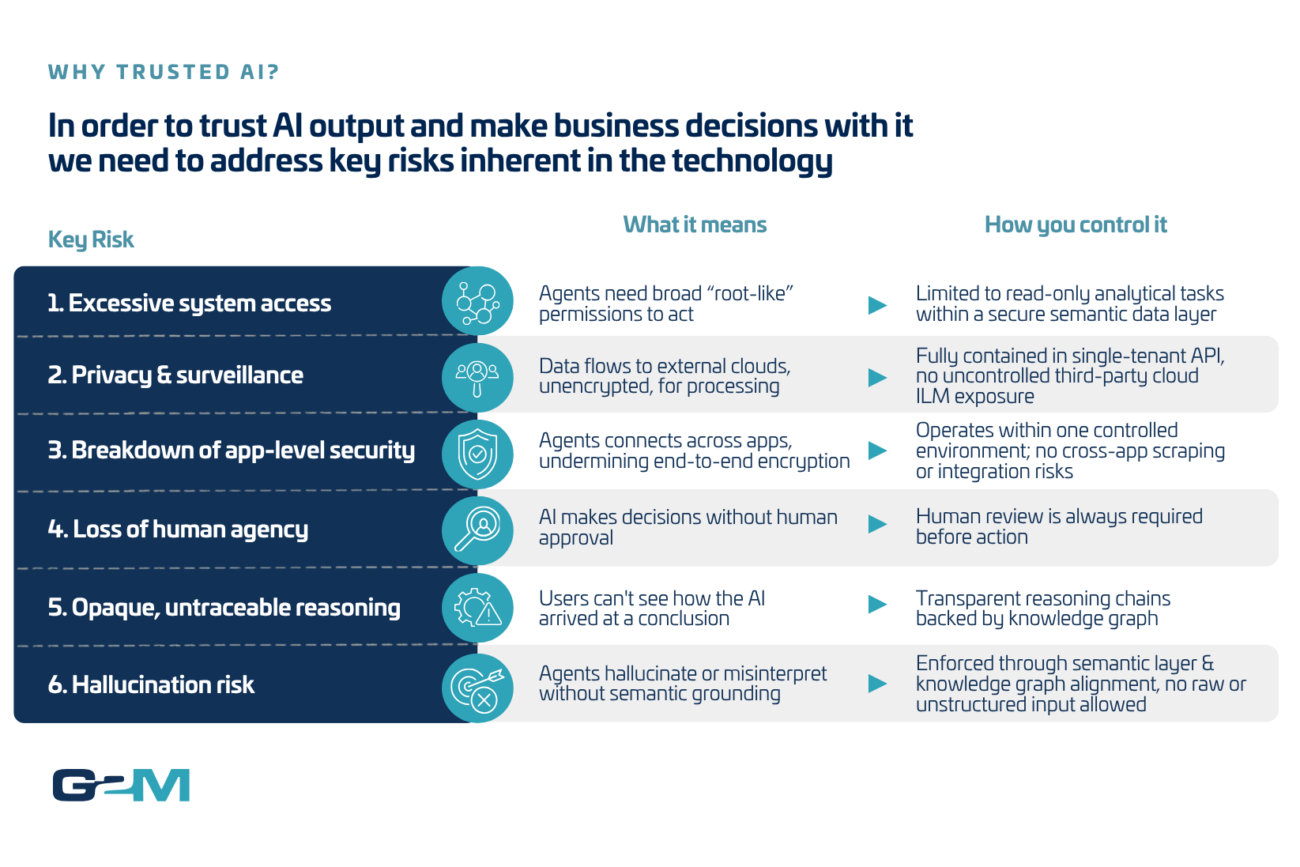
- Excessive system access: agents need broad, root-like permissions to act.
- Privacy and surveillance: data flows to external clouds, unencrypted, for processing.
- Breakdown of app-level security: agents connect across apps, undermining end-to-end encryption.
- Loss of human agency: AI makes decisions without human approval.
- Opaque, untraceable reasoning: users can’t see how the AI arrived at a conclusion.
- Hallucination: agents hallucinate or misinterpret without semantic grounding.
Each risk, a real example, and the control that solves it, below.
1. Excessive system access
To act, an agent needs permissions, so vendors hand it broad, root-like access across your stack. That convenience is the risk. One manipulated instruction, and an over-permissioned agent has the standing rights to export records, overwrite figures, or trigger actions in production.
In 2025, researchers showed exactly this: a critical flaw dubbed ForcedLeak let attackers trick Salesforce Agentforce into exfiltrating CRM data through a single planted lead, because the agent followed instructions it should never have had the latitude to execute.
Solution: Invert the default. Restrict the AI to read-only analytical work inside a secure semantic data layer. It can analyze, explain, and recommend. It cannot reach into systems and change them on its own. Access becomes the exception you grant deliberately, not the baseline you scramble to govern later.
2. Privacy and surveillance
Many AI tools ship enterprise data to external clouds, often unencrypted, and run it through third-party model providers you don’t control. Every one of those hops is a place your customer, financial, and competitive data can be retained, inspected, or exposed. Samsung learned this the hard way and banned ChatGPT after engineers pasted source code and internal meeting notes into it, sending confidential data to a service it couldn’t pull it back from.
Solution: Keep processing inside your walls. Run inference in a fully contained, single-tenant environment with no exposure to third-party cloud LLMs. Your data never leaves a perimeter you own and can audit.
3. Breakdown of app-level security
This is the risk boards worry about most: AI making material decisions with no human in the loop. Automation is seductive precisely because it removes the human step, and the moment you remove it on a decision that matters, you remove accountability with it.
Air Canada learned the cost in court: a tribunal held the airline liable for what its chatbot told a customer, rejecting the argument that the bot was a separate entity. The automated answer was wrong, no human had vetted it, and the company owned the outcome.
Solution: Human review before action, always. This is Human Oversight, the fifth pillar of Trusted AI. AI surfaces the what, the why, and the what-if; leadership decides what to do. That separation isn’t a brake on the technology. It’s where the return comes from.
4. Loss of human agency
This is a different failure: an agent demolishing the security model inside your own stack. When it reaches across applications, it routes around the access controls and encryption each app was built to enforce.
The EchoLeak vulnerability in Microsoft 365 Copilot made the danger concrete: a single crafted email could make the assistant pull data from OneDrive, SharePoint, and Teams and leak it, with no click from the user.
Solution: Keep analysis in one governed environment instead of wiring agents between apps. No cross-app scraping, no improvised connectors, no shadow pipelines shuttling data between tools. Each application keeps the security boundary it was designed with.
5. Opaque, untraceable reasoning
If users can’t see how the AI reached a conclusion, they can’t defend it. A confident answer with no visible reasoning is worthless the moment a CFO or a PE sponsor pushes back.
After viral complaints that the Apple Card gave men far higher credit limits than their wives, neither the customers nor, by many accounts, the bank could clearly explain how the algorithm set them. A regulator opened an investigation into the black box, and the episode became a public lesson in the cost of reasoning no one can show.
Solution: Combine two pillars. Causal Reasoning attributes outcomes to specific drivers rather than reporting correlations. Transparent Reasoning gives every conclusion a visible chain of logic, backed by a knowledge graph, with assumptions you can inspect and challenge. The answer arrives defensible, auditable, and ready for the people who will interrogate it.
6. Hallucination
Generative models invent plausible, confident, wrong answers when they lack grounding. In a chat toy that’s a curiosity. In an enterprise decision system it’s a way to act on fiction. In Mata v. Avianca, two lawyers were sanctioned after ChatGPT invented court cases, complete with fabricated citations, that they filed as real.
Solution: You don’t fix hallucination with a better prompt. You fix it with grounding. Enforce every output through a semantic layer and a knowledge graph that encode your actual business: your metrics, definitions, hierarchies, and rules. Don’t let raw, unstructured input drive conclusions. When the AI can only reason over governed data and explicit business semantics, it loses the room it needs to make things up.
The pattern underneath
Read the six controls together and one design philosophy emerges. Constrain access. Keep processing inside your perimeter. Don’t let agents bridge your apps. Ground every answer in governed data and business semantics. Show the reasoning. Keep a human in the loop on anything that matters.
Together, the six controls form an architecture, and that architecture is what separates AI you can experiment with from AI you can run a business on.
This is exactly what G2M’s Trusted AI framework is built to deliver: a decision system, not a model or a chatbot, that addresses all six risks by design and produces accurate, explainable, context-aware insights leaders can take to the board and defend. If you’re putting AI anywhere near decisions your business depends on, see how the framework works and what it looks like in practice.
Find out where your organization stands
Download the Trusted AI Executive Guide
Get the executive guide that covers the five pillars, the implementation roadmap, and the economic case for Trusted AI.
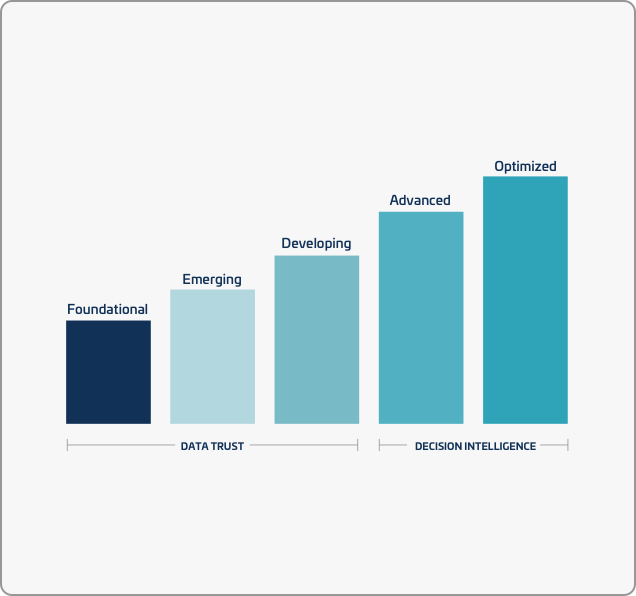
Take the Trusted AI Assessment
Take the 8-domain readiness assessment and get a clear picture of your Trusted AI architecture: where it’s sound, and where the gaps are.
Frequently asked questions
-
In the enterprise, six risks show up again and again: excessive system access, privacy and surveillance, breakdown of app-level security, loss of human agency, opaque and untraceable reasoning, and hallucination. They aren’t isolated bugs. Each is a structural property of how AI gets deployed, and each has a specific architectural control rather than a policy workaround.
-
You mitigate AI risks with architecture, not caution. Constrain the AI to read-only analysis inside a governed environment, keep processing inside a perimeter you own, require human review before any action, and ground every output in governed data and a knowledge graph so conclusions are traceable. Policies and training help at the margins, but they don’t remove the failure mode the way a design decision does.
-
The companies that manage AI well treat trust as a layer they build, not a setting they toggle. They unify data into a single governed source, encode their business rules into a semantic layer, make every conclusion show its reasoning, and keep a human accountable for material decisions. That combination is what G2M’s Trusted AI framework operationalizes, so AI outputs hold up under board and audit scrutiny.
-
Agents introduce two security risks beyond a normal model: excessive access and cross-app exposure. Given broad permissions, an agent can be manipulated into exporting or altering data, as the ForcedLeak flaw in Salesforce Agentforce showed. And because agents reach across applications, they can route around the controls each app enforces, the pattern behind the EchoLeak vulnerability in Microsoft 365 Copilot. The control is least-privilege, read-only access inside one governed environment.
-
Shadow AI is employees using unsanctioned AI tools on company data. The risk is that confidential information leaves your control the moment it’s pasted into a public model. Samsung banned ChatGPT internally after engineers fed it source code and meeting notes. Containing inference in an approved, single-tenant environment removes the reason people reach for unsanctioned tools in the first place.
-
When AI acts without oversight, accountability still lands on the company. A tribunal held Air Canada liable for what its chatbot told a customer, and two lawyers were sanctioned in Mata v. Avianca after filing fabricated cases ChatGPT invented. Human review before action and transparent, auditable reasoning are what keep automated decisions defensible.
Learn more about the Trusted AI framework: g2m.ai/trusted-ai