





AI-informed decisions you can defend to your board.
What is an enterprise AI governance framework?
An enterprise AI governance framework sets which business decisions AI may inform, where an executive must approve, and how every override is recorded, on top of the access and compliance controls you already run.
The gap in most AI governance programs
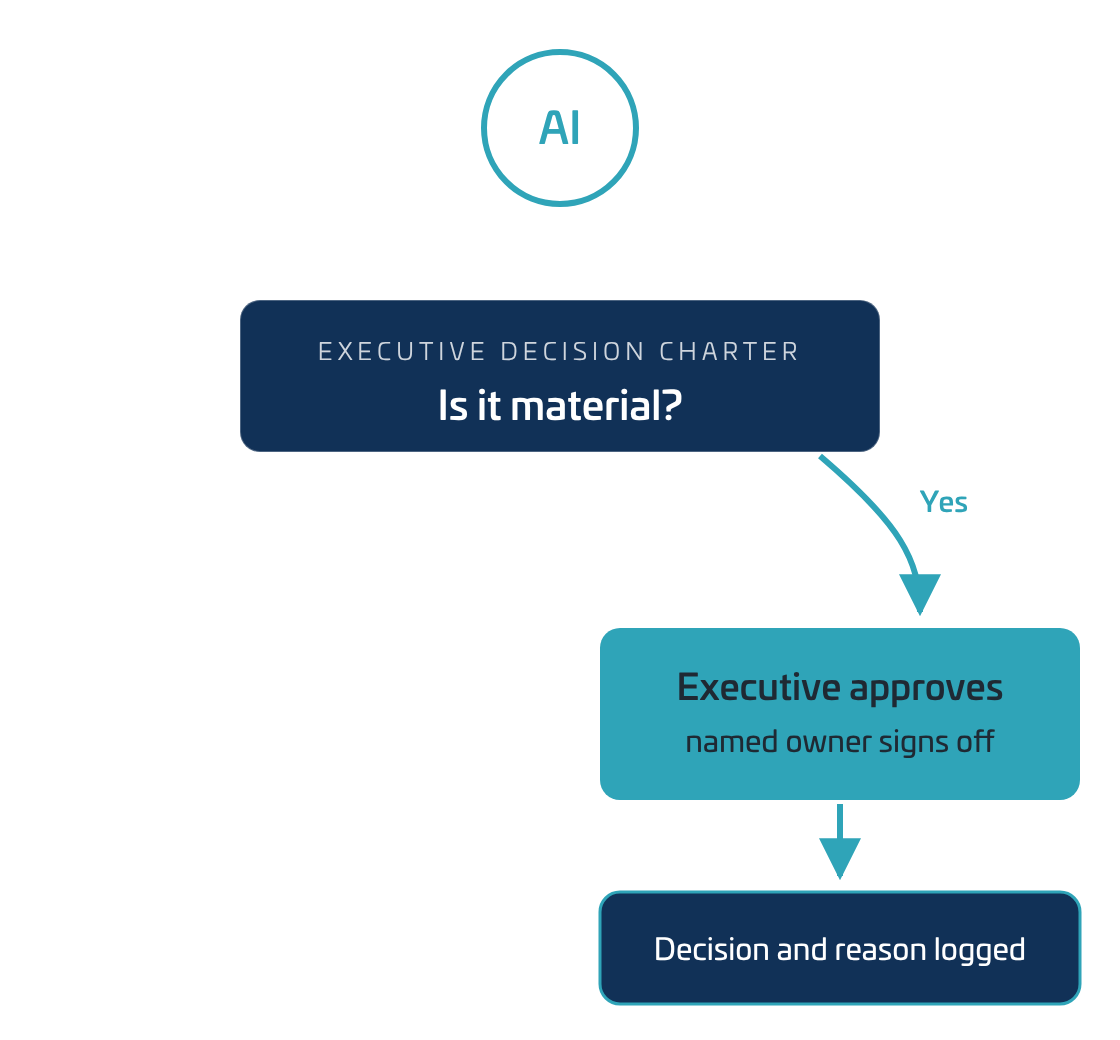
Many AI governance programs cover model risk, data access, and regulation. Very few programs name the executive who must approve an AI-informed decision, price, or budget shift, or keep a record when someone overrides the AI.
That gap sits in the decisions that move money: revenue forecasts, pipeline allocation, pricing, budgets, and the reallocation of marketing spend. For example, an AI tool sees sales falling in one region and recommends moving reps there or lowering the price. A manager approves the change. If the quarter still misses, the board will ask who signed off and what information they had.
Our Trusted AI book puts it plainly: “No board of directors or group of investors will accept ‘the AI told us to do it’ as a valid justification for a poor decision.” Accountability stays with people, so governance has to say which people, for which decisions. For the complete picture of the risks AI presents to the business, see our post on the six risks of AI.
If you’re the one setting up AI governance, start by writing down who approves each type of AI-informed decision and where that approval is recorded. That’s the question your CFO will ask first.
The five pillars of a trusted AI governance framework
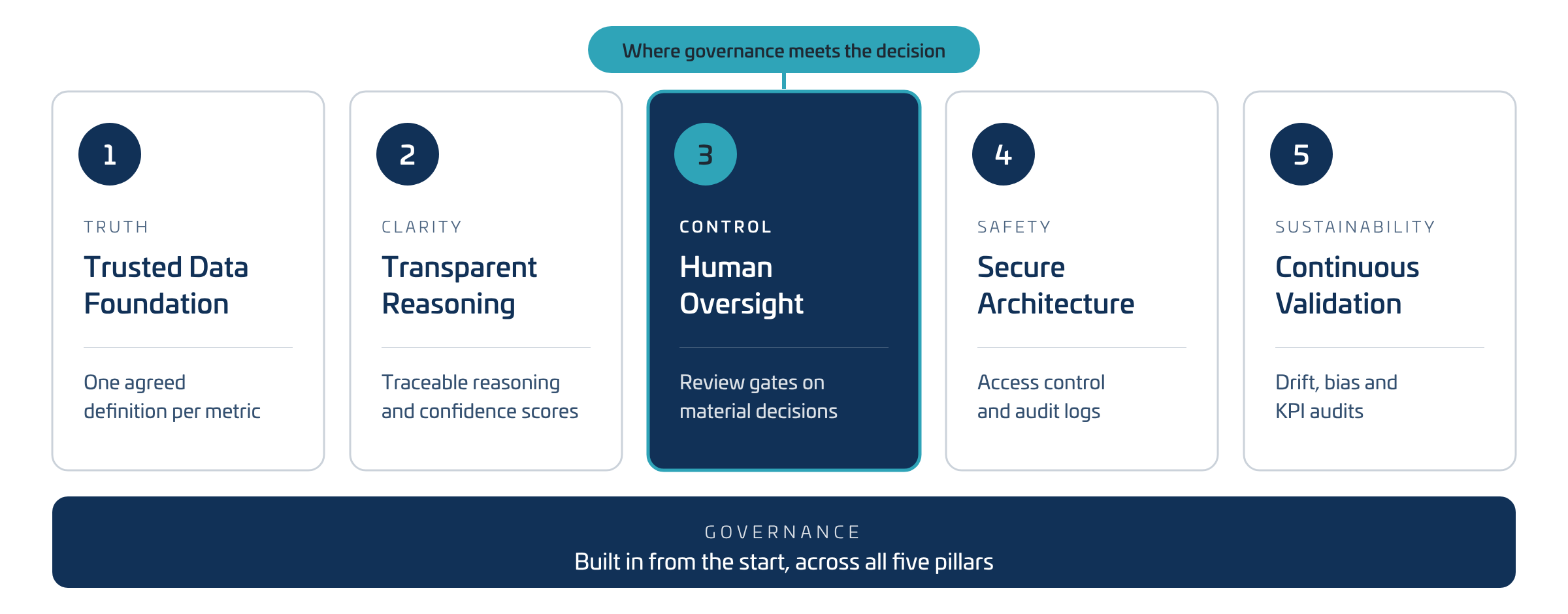
Our Trusted AI framework has five pillars. Each one governs a different part of how AI reaches a decision: the data, the reasoning, the people, the security, and the upkeep. Governance is the structural foundation of trust, so build it in from the start.
- Trusted Data Foundation (truth). Unified pipelines and a semantic layer give every metric one agreed definition, so AI reasons over numbers the business accepts.
- Transparent Reasoning (clarity). Every insight carries a traceable chain of reasoning, with decomposition, statistical validation, and confidence scores, so a leader can check how the AI got there.
- Human Oversight (control). Review gates on forecasting, resource allocation, pricing, and other material decisions keep executives in charge of strategy.
- Secure Architecture (safety). Single-tenant environments, end-to-end encryption, role-based access, and complete audit logs control who uses the system and record what they did.
- Continuous Validation (sustainability). Drift detection, bias monitoring, KPI audits, and quarterly trust reviews keep the system aligned as the business changes.
Who governs AI decisions
For the CFO, COO, or CRO who signs off.
Every material recommendation has a named owner, an executive sign-off, and a logged reason when someone overrides it. Three structures make that work.
The Executive Decision Charter. A living document that sets which recommendations AI can make, which require explainability, and which must never be automated. Senior leadership debates and reviews it regularly. A charter might, for example, require human approval for any compensation change above 5%.
The AI Governance Board. A cross-functional group that “convenes quarterly, much like a board risk committee.” In a typical session, the CFO reviews recent AI-driven pipeline forecasts, the CMO raises a conflict over what counts as a marketing-qualified lead, and the CTO flags a change to data access rules. At quarter end, leadership reviews error rates and drift events and resets the trust boundaries as the business logic changes.
Metric owners. Each key KPI gets a steward, usually the functional leader responsible for that number. A change to a definition goes through a staged process: proposal, stakeholder review, test runs, adoption, then full rollout. The agreed definitions live in one shared dictionary of metrics, the semantic layer, so the AI, board presentations, and management reports all use the same ones.
AI governance framework example: a disputed pipeline number
AI flags a 10% drop in qualified pipeline. Marketing says the AI is wrong, because its HubSpot dashboard shows MQLs are up. Sales says the AI is right, because lead quality has fallen. Finance is working from a different spreadsheet.
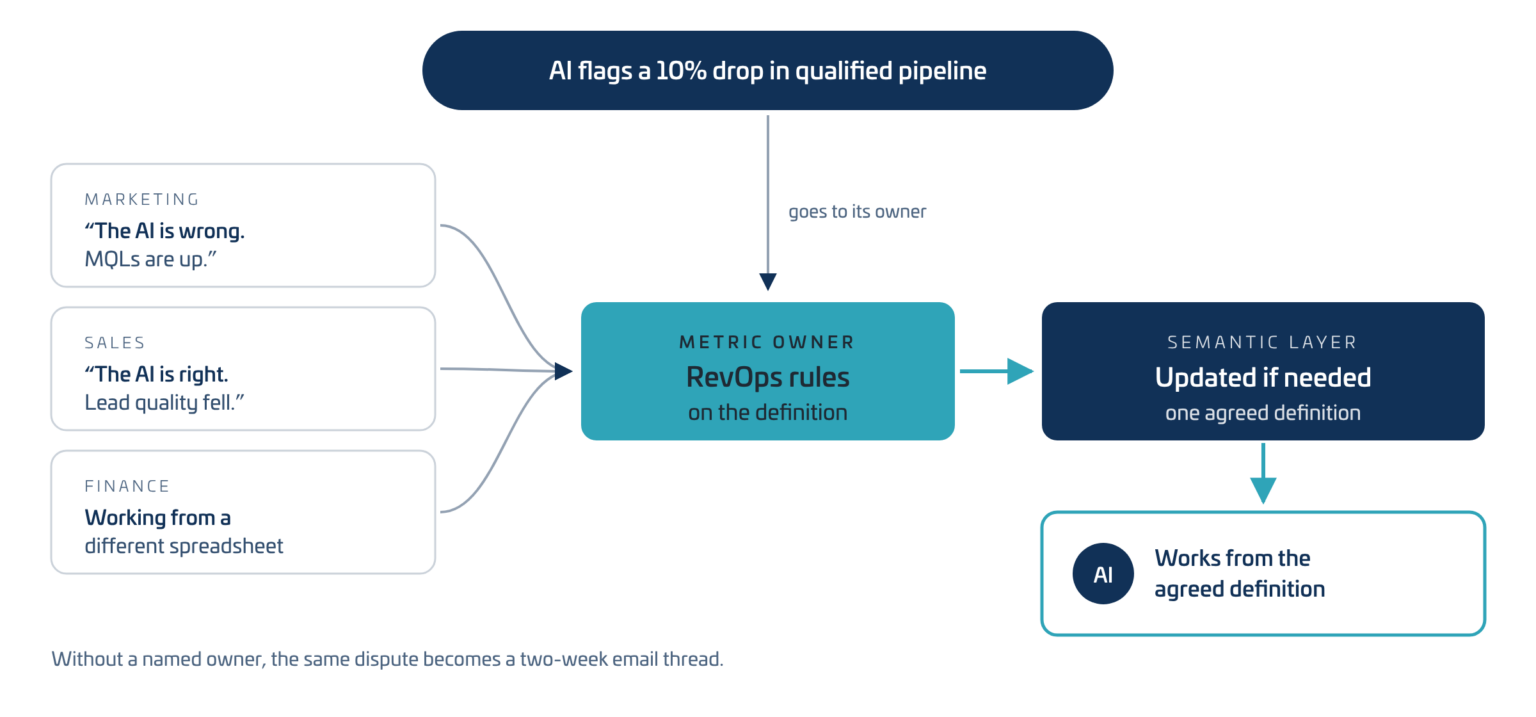
Without a governance board, that becomes a two-week email thread. With an AI governance framework in place, the pipeline metric already has an owner, likely RevOps. The owner rules on the definition, updates the semantic layer if needed, and the AI works from the agreed definition.
Because the owner was named before the dispute started, nobody has to settle who makes the call.
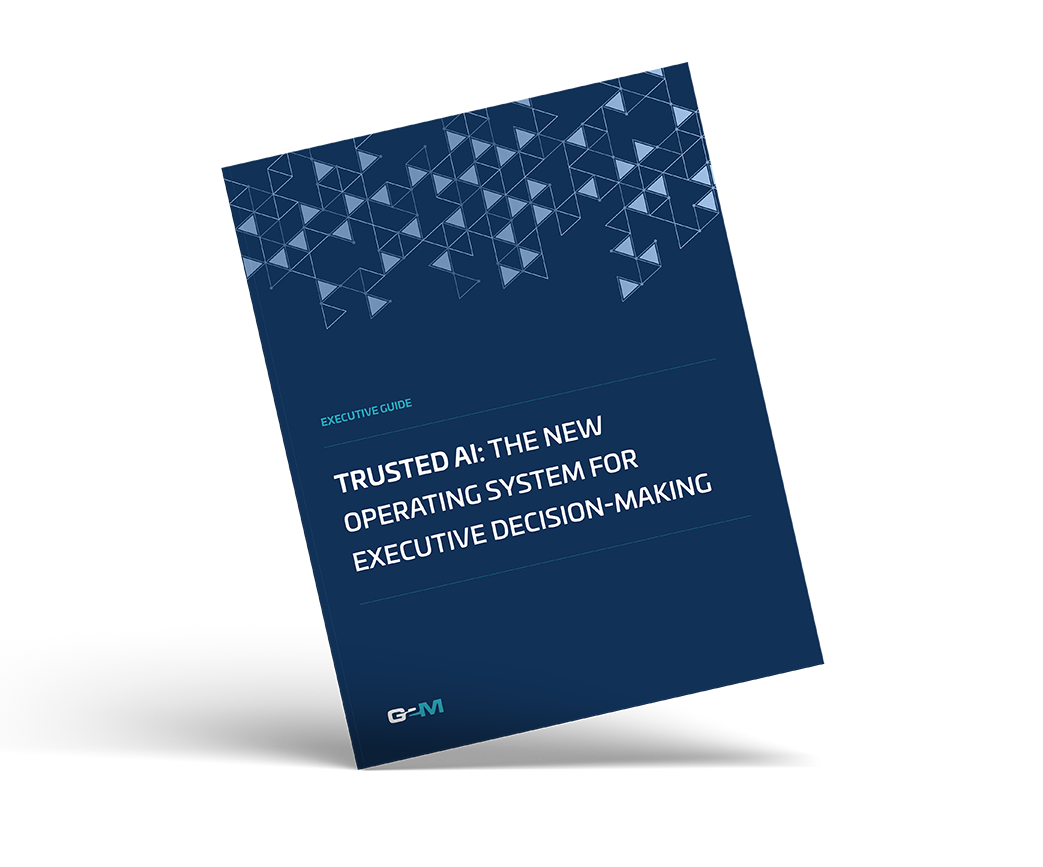
Send your CFO or COO the 10-page version. The Trusted AI Executive Brief is written for executives and shows where governance sits in the full Trusted AI framework.
Download the Trusted AI Executive GuideHow to implement AI governance
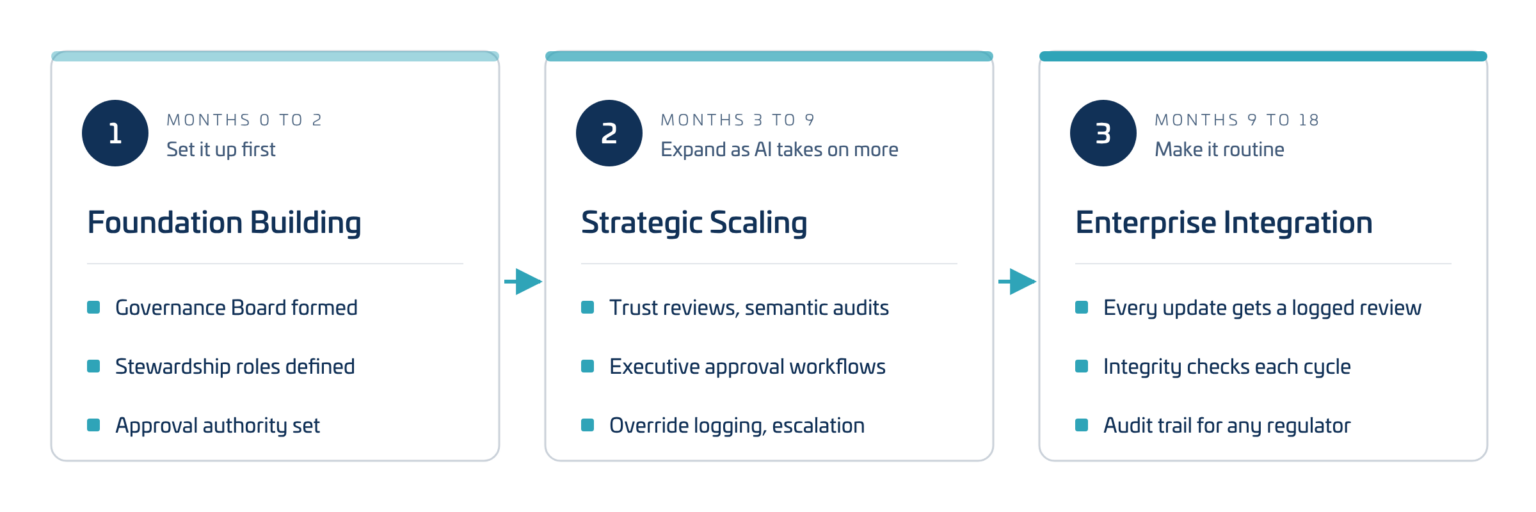
Roll out governance in three stages:
- Set it up first (Foundation Building, months 0 to 2). Stand up the AI Governance Board, define stewardship roles, and clarify approval authority and compliance requirements before the first pilot.
- Expand it as AI takes on more (Strategic Scaling, months 3 to 9). Add recurring model recalibration, structured trust reviews, cross-functional semantic audits, executive approval workflows for major updates, override logging, and escalation procedures.
- Make it routine (Enterprise Integration, months 9 to 18). Every model update, edge-case override, and key insight triggers a logged review. Integrity checks run as part of standard governance cycles, which gives any executive or regulator an audit trail.
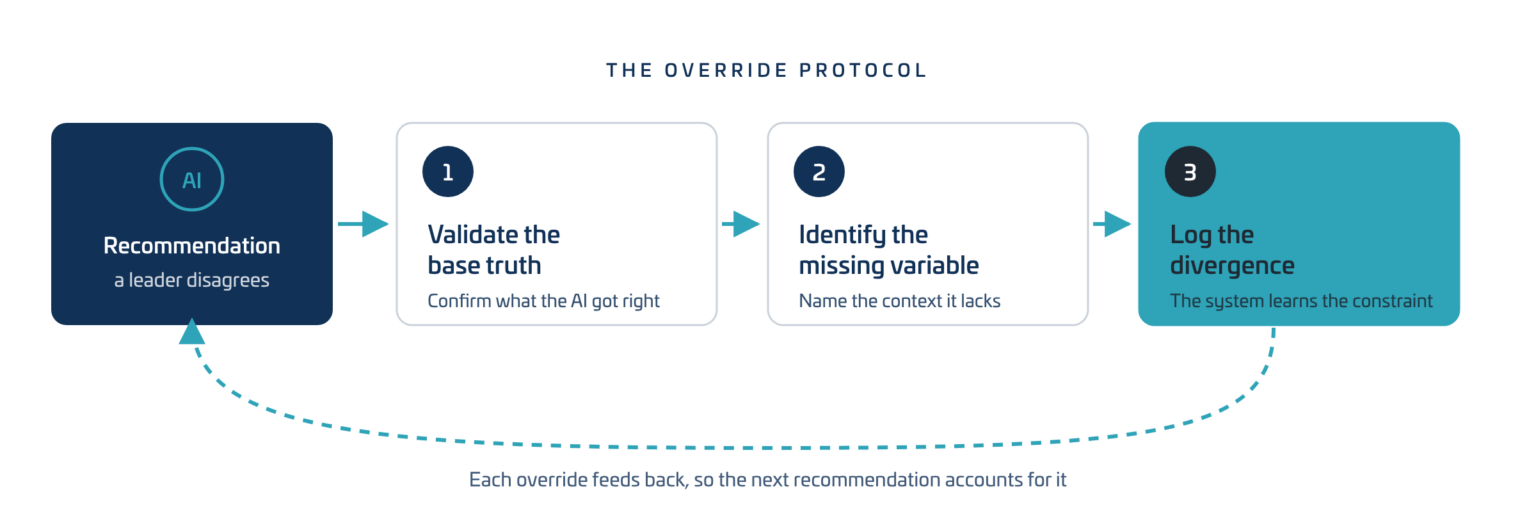
Overrides need a protocol of their own. When a leader disagrees with a recommendation, the Override Protocol treats the disagreement as a data point:
- Validate the base truth. Confirm what the AI got right (“Yes, margins are dropping”).
- Identify the missing variable. Name the context the AI lacks, such as a pending regulation.
- Log the divergence. Feed the decision back so the system learns the new constraint for next time.
We set up the Executive Decision Charter, the AI Governance Board, and override logging inside your own Snowflake, Databricks, or BigQuery environment, alongside the data foundation they govern.
AI governance checklist
Run these six checks against your current setup. Each unticked item means a material decision could reach execution without a named owner.
- Mandated human approval. Human approval is required for all financially or strategically material AI recommendations.
- Logged override mechanisms. Formal override processes exist, with justifications logged for audit.
- Active governance board. A cross-functional AI governance board meets regularly to review performance, risk, and alignment.
- Clear ownership. Ownership is documented for models, data pipelines, and business decisions.
- Documented ethical review. Ethical considerations and biases are documented and reviewed.
- Enforced access controls. Role-based access controls are enforced to ensure proper data and model access.
Where NIST, the EU AI Act, and ISO 42001 fit
If your AI governance already maps to NIST, the EU AI Act, or ISO 42001, the summaries below show what each one covers and which decisions it still leaves to your leadership team.
NIST AI Risk Management Framework. The US National Institute of Standards and Technology released it in January 2023 for voluntary use. Its core has four functions: govern, map, measure, and manage. Govern runs through the other three and builds the culture and processes for managing AI risk.
EU AI Act. The EU’s risk-based regulation bans a small set of uses and sets obligations for AI systems classed as high-risk. For those systems, Article 14 requires that people can oversee them while in use, including the ability to “disregard, override or reverse the output.” The high-risk rules apply from December 2, 2027, and from August 2, 2028, for AI built into regulated products.
ISO/IEC 42001. Published in December 2023, it sets requirements for “establishing, implementing, maintaining, and continually improving” an AI management system, for any organization that provides or uses AI.
All three give you a structure for managing AI risk. Your leadership team still decides the specifics, such as whether a price change above a set amount needs your CRO’s sign-off, or who owns the definition of qualified pipeline.
Frequently asked questions
-
An enterprise AI governance framework sets which business decisions AI may inform, where an executive must approve, and how every override is recorded, on top of the access and compliance controls you already run. It names an owner for each material decision and keeps a record when someone overrides the AI.
-
A policy states the rules for how your company uses AI: approved tools, acceptable uses, and data handling. A framework is the structure that runs those rules: who decides, who approves, how overrides are recorded, and how often it all gets reviewed. The policy sits inside the framework.
-
Data governance manages the data itself: quality, security, standards, and access. AI governance covers what happens when AI uses that data to inform a decision. You need both, because AI working from inconsistent data amplifies the inconsistency.
-
Both platforms govern data and AI assets. Databricks does it through Unity Catalog and Snowflake through Horizon Catalog, with the access controls and policies any framework needs. Deciding which recommendations need an executive’s approval, and who owns the definition of pipeline, is up to your leadership team. We work inside your Snowflake or Databricks environment to set them up.
-
Approval applies only to financially or strategically material decisions, and the Executive Decision Charter sets that threshold in advance. Routine recommendations run on their own, and a disputed metric goes straight to its owner. Oversight works as a safety valve.
-
With the same structures and tighter limits, because an agent can act on a recommendation as well as make it. Tier each agent by what it can touch: the data it reads, how much it does on its own, and which systems it can change. A drafting agent that only suggests needs a named owner.
An agent that writes to a system of record needs an evaluation gate, logged activity, and executive approval for anything material. Re-tier an agent whenever it gains a connector, an action, or a wider audience. Agentic AI without trust layers is a disaster waiting to happen. For the full operating model, read why agentic orchestration is an operating model and who’s governing the door on MCP servers.
-
Quarterly, much like a board risk committee, with a leadership review at the end of each quarter. Day-to-day issues, such as a disputed metric, go straight to that metric’s owner and don’t wait for the meeting.
-
The override is logged with its reason and fed back into the system, so the AI learns the constraint. The Override Protocol has three steps: validate the base truth, identify the missing variable, and log the divergence.
Get the Trusted AI Executive Brief
Forward the 10-page Trusted AI Executive Brief to the executives who sign off on AI-informed decisions. It covers all five pillars, with governance in context. Free download.