






Your AI is picking its own definition of pipeline.
What is a semantic layer?
A semantic layer is the single place a business defines its metrics, such as revenue, pipeline, and churn, so every team and tool, AI included, calculates them the same way.
The Problem: One metric, two teams, two answers
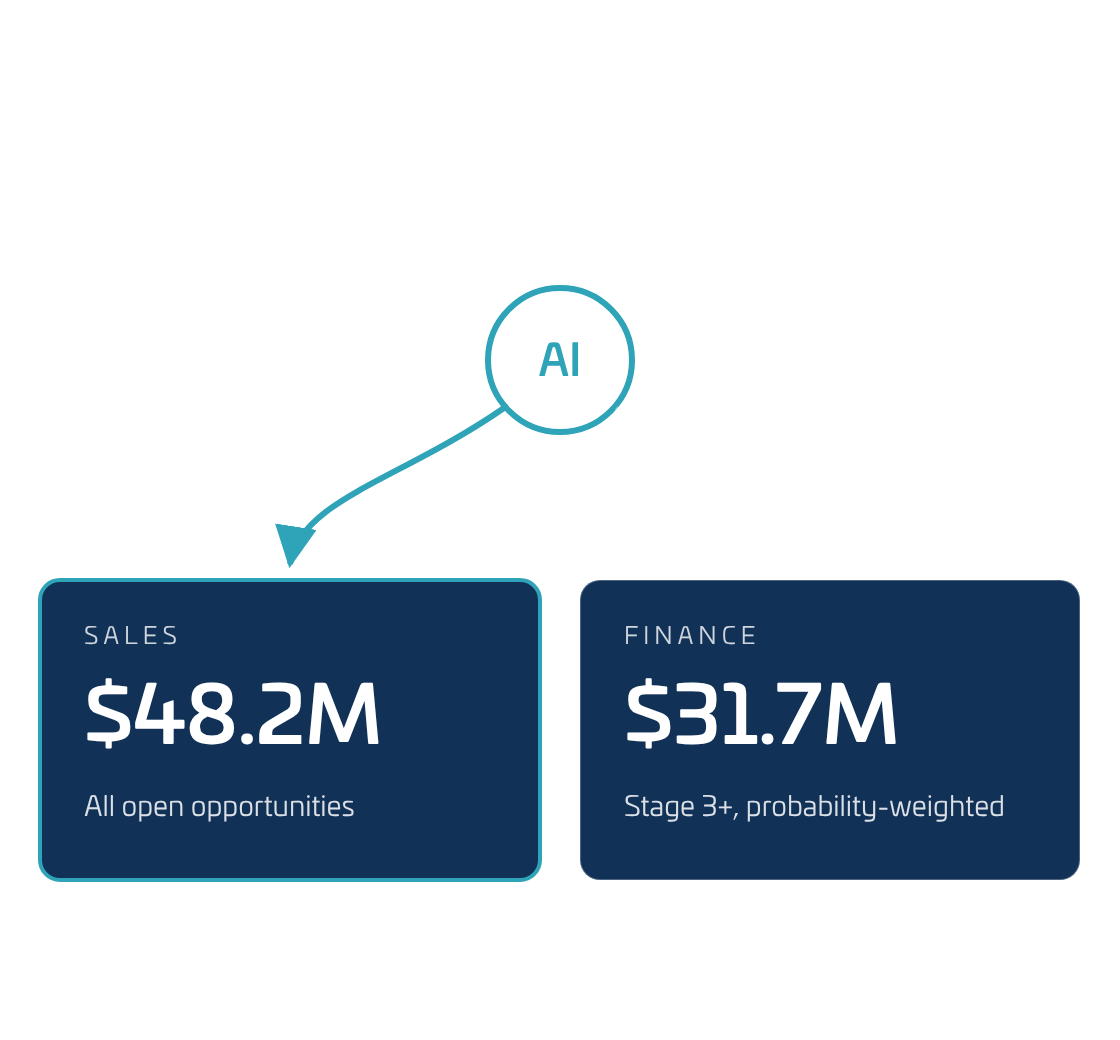
Ask your head of sales for Q4 pipeline and you'll get one number. Ask finance and you'll get another, and both can defend their math.
Sales counts every open opportunity. Finance counts deals at stage 3 or later and weights each one by its probability to close, which suits the forecast it owns. The trouble starts when the two numbers land in the same meeting with no note about which is which.
Now point an AI tool at the data warehouse that holds the CRM, billing, and finance data behind both reports, and ask the same question. It finds an opportunity table, a stage field, and a probability field. It picks a calculation, runs it, and returns a clean figure with a sentence of explanation. Nothing in the answer tells you whose definition it used. Ask again next week with different wording and it may pick the other one.
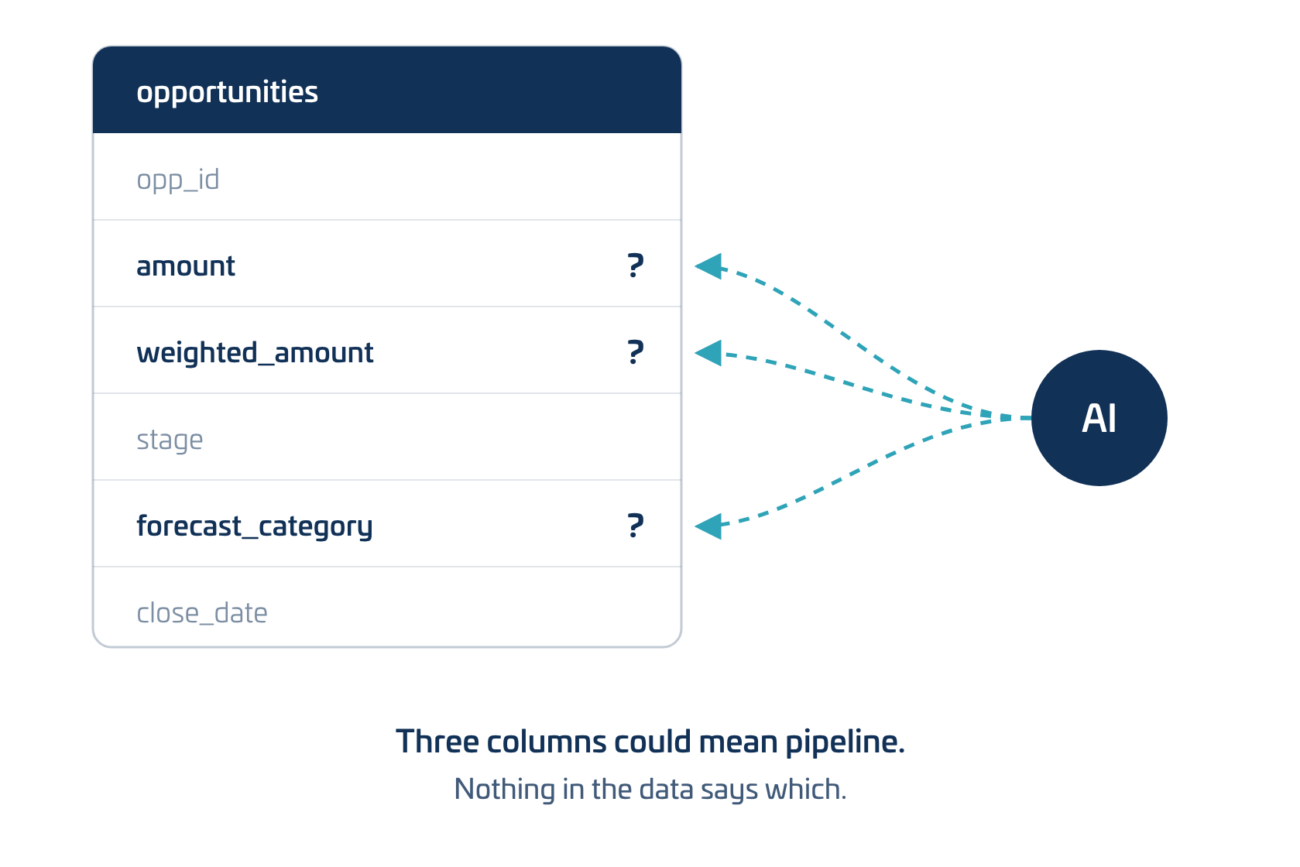
This is semantic drift: a metric's definition splitting between teams, or shifting over time, without anyone deciding that it should. People tend to catch it after a few awkward meetings, but an AI tool has no way of noticing.
Churn splits the same way. In a telecom example from G2M's Trusted AI book, marketing measured churn using user-requested dates, while finance used billing termination dates. When the AI reported a drop in churn, debates erupted.
A quick test: if two of your teams can report different revenue or pipeline numbers for the same period, and both can defend their method, you have semantic drift, and so do your AI tools. (We wrote about what this does to go-to-market teams in The GTM Death Spiral.)
What a semantic layer does
A semantic layer sits between your data warehouse and every tool that reads from it: dashboards, spreadsheets, planning models, and AI. It holds the business meaning that raw tables don't carry.
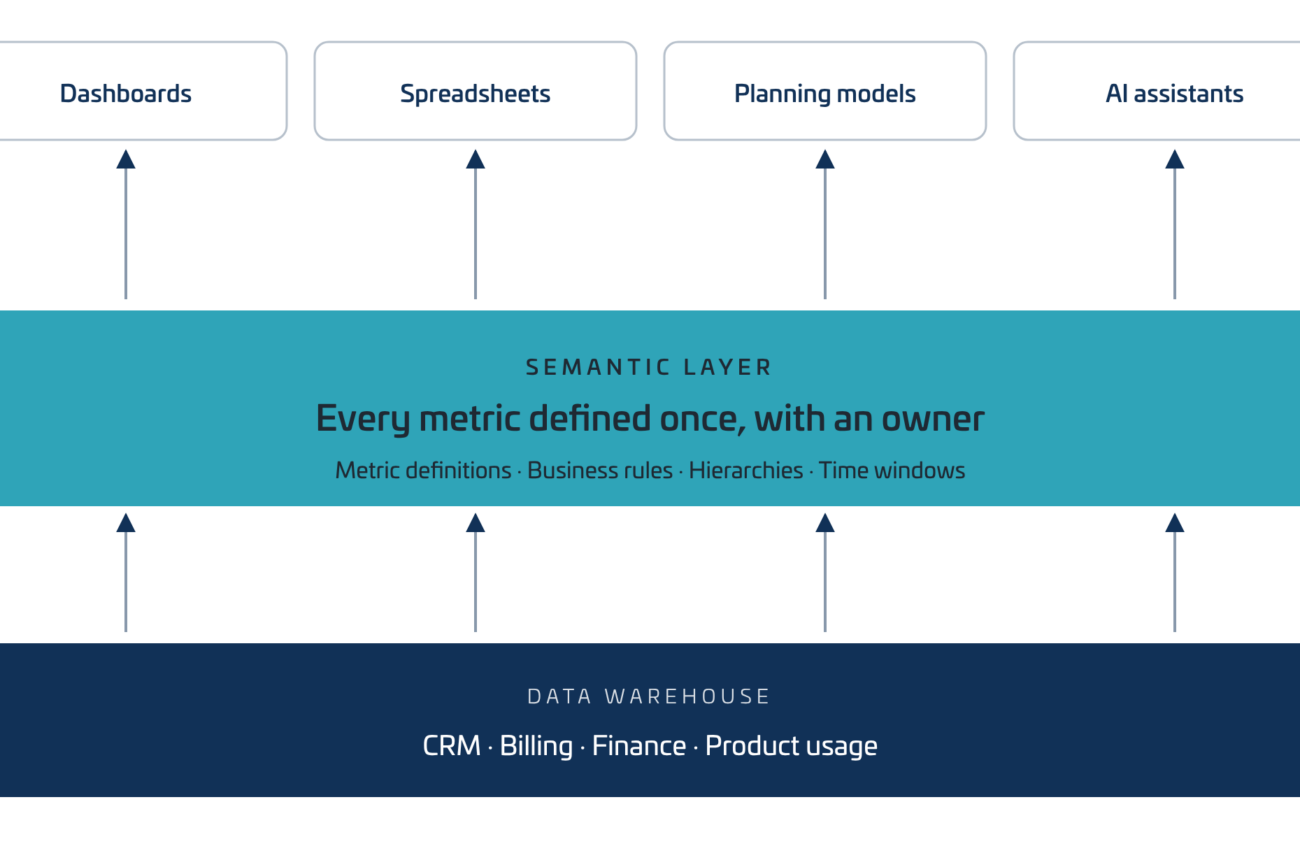
It is a canonical dictionary for metrics and calculations that ensures every metric is defined once and consistently applied across all teams and reporting tools.
In practice, a working semantic layer holds four kinds of definitions:
- Metric definitions. The formula for pipeline, churn, CAC, and every other KPI the business reports, written once.
- Business rules. What counts as a qualified lead, when a customer counts as churned, which date marks a deal as closed.
- Hierarchies. One version of region, segment, channel, and product line, so “West region” means the same territory in every report.
- Time windows. Fixed meanings for week over week, quarter to date, and trailing twelve months.
Semantic layer example
Two illustrative entries from a go-to-market semantic layer:
| Metric | Definition | Owner |
|---|---|---|
| Pipeline (forecast) | Open opportunity value at stage 3 or later, weighted by stage probability | Finance |
| Logo churn | Customers with no active contract 30 days after their term ended, divided by customers at the start of the period | Customer success |
Once a definition lives in the semantic layer, every tool that asks for "pipeline" gets the same calculation. Disagreements about the number get settled in one place, and the rule only changes when someone changes it on purpose.
Why AI needs a semantic layer
Agents pointed at your data warehouse, and assistants like Anthropic's Claude and Snowflake Cortex, read the structure of your data: table names, column names, and whatever documentation exists. When the meaning of a metric isn't written down, they infer it. The inference is often reasonable, but you can't see it, because the answer reads just as fluently whether the tool guessed right or wrong.
G2M’s Trusted AI framework, five connected pillars that make AI defensible enough for high-stakes decisions, treats this as a reasoning problem. Its second pillar, Transparent Reasoning, builds every insight through a fixed chain of steps, and step 2 is Semantic Interpretation: data is mapped to canonical definitions and business terms, and ambiguity is resolved at the semantic layer. That step can only resolve ambiguity against definitions that exist. With no semantic layer, the model fills the gap on its own.
The cost shows up when someone questions the number. A CFO who asks where a forecast came from needs to see which formula produced it and who agreed to that formula, and the semantic layer is where that record lives. Without one, the honest answer is “the AI worked it out,” and that answer doesn’t hold up in a board meeting.
This is why the semantic layer sits in the first pillar of Trusted AI, Trusted Data Foundation: “Unified pipelines and a semantic layer enforce consistent KPI definitions and encode your unique business logic.” AI working from inconsistent definitions amplifies the inconsistency, in every answer it gives and faster than any analyst could.
Deciding what goes in the semantic layer
Plenty of teams already run semantic layer software. dbt, Looker, and Snowflake can all store metric definitions, and all three are G2M partners. The harder work is deciding what goes in the tool.
Somebody has to get Finance, Sales, and Marketing to agree on one formula for pipeline, settle what counts as a qualified lead, and name an owner for each metric. Until that happens, the tool holds whatever the last analyst entered, or three competing versions of the same KPI.
G2M’s Trusted AI book names the biggest risk definitional drift: a functional leader quietly disagrees with the central definition, stops using it, and has an analyst build a shadow report in Excel. Its answer is what it calls semantic diplomacy: “You cannot just code a metric; you must negotiate it.”
Questions to take to your CFO or CRO
If you own the data, you already know where the definitions conflict. Settling them is also what gets your team’s analysis acted on instead of argued over. These questions help the people who own the numbers see the problem too.
- Do Sales and Finance report the same pipeline figure for the same quarter?
- When a forecast misses, can we say which definition of pipeline it was built on?
- Does each core metric have a named owner who approves changes to its formula?
- Has an AI tool ever given us a number nobody could trace back to a formula?
- If the board asked how we calculate churn, would every team give the same answer?
If you can’t answer yes to two or more, fix the definitions before you ask AI to do more.
These questions start the conversation. The Trusted AI Executive Brief gives your CFO the full framework the semantic layer belongs to, in 10 pages.
Download the Trusted AI Executive GuideHow to build a semantic layer
Most semantic layer projects follow the same four steps, whatever tool ends up holding the definitions.
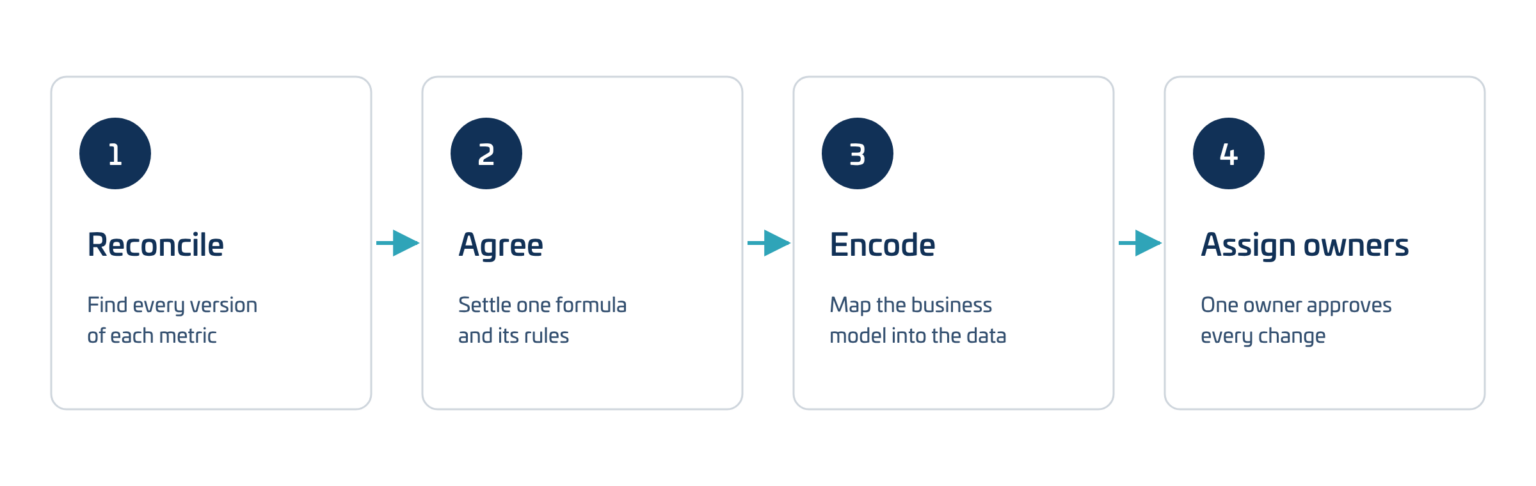
- Reconcile what exists. Find every version of each core metric across dashboards, spreadsheets, and systems, and note where the formulas differ.
- Agree on one definition. Get the teams that use each metric to settle on a single formula and the business rules behind it.
- Encode the business model. Map revenue mechanics, funnel logic, and rate, volume, and mix drivers into the data layer, so AI can explain changes as well as report them.
- Assign owners. Give each metric a named owner who approves changes, so the definitions don’t drift apart again.
How G2M does it
G2M builds the semantic layer as part of a Trusted Data Foundation, the first of five pillars in its Trusted AI framework, alongside unified data pipelines and business model encoding.
The teams that use each metric agree on its definition, filtering logic, hierarchies, and time windows, and each KPI gets an owner. G2M’s Trust Operations Model calls for a neutral semantic steward to negotiate contested definitions across the C-suite, and for any later change to go through a staged review before rollout. G2M’s 30-day sprint, the Clarity Program, includes the creation of your core semantic layer.
G2M’s Trusted AI book offers a scenario. Imagine the AI flags a 10% drop in qualified pipeline. Marketing says the AI is wrong because its HubSpot dashboard shows MQLs are up. Sales says it’s right because lead quality has fallen. Finance is looking at a different spreadsheet entirely. Without a governance board, that becomes a two-week email thread.
With one, a pre-defined owner of the pipeline metric (likely RevOps) rules on the definition, updates the semantic layer if needed, and the dispute is settled “in 24 hours, not 14 days.”
The work happens inside your existing stack, whether that’s Snowflake, Databricks, or BigQuery, and alongside the dbt or Looker layer you may already run. G2M doesn’t sell a separate semantic layer product.
Frequently asked questions
-
A semantic layer is the single place a business defines its metrics and business rules, so every dashboard, report, and AI tool calculates them the same way. It sits between the data warehouse and the tools that read from it.
-
A data warehouse stores the data. A semantic layer stores what the data means: how each metric is calculated, which rules apply, and how categories like region or segment roll up. The warehouse holds the opportunity table. The semantic layer says which opportunities count as pipeline.
-
The term “context layer” is used loosely, but it usually means the business knowledge an AI system needs to interpret data: how the company makes money and which drivers move each number. A semantic layer defines what the metrics are. In G2M’s framework, that context is business model encoding, which G2M’s Trusted AI book describes as what lets AI “interpret not only what changed, but why it changed.” It sits in the same foundation as the semantic layer, and AI needs both.
-
No, though they work together. A semantic layer defines metrics and the rules for calculating them. A knowledge graph maps how business concepts relate to each other. In G2M’s Trusted AI framework, knowledge graph reasoning is its own step in the reasoning chain, encoding relationships among metrics, hierarchies, business rules, and historical context, and it builds on the definitions the semantic layer provides.
-
Not on their own. Databricks and Snowflake are data platforms, and both offer features for defining metrics (Databricks metric views and Snowflake semantic views). Those features can hold a semantic layer, as dbt and Looker can. None of them can decide your definitions for you. G2M works with all four.
-
Five things: canonical definitions for every core metric, explicit business rules, consistent hierarchies and time windows, an encoded business model, and a named owner for each metric. Without the last two, AI can calculate a metric consistently but can’t explain why it moved, and nobody is accountable when a definition needs to change.
-
Yes, if you need answers you can defend. Without written definitions, AI tools infer meaning from table and column names. The answer may be right, but you can’t show how the number was calculated or confirm it matches the definition Finance uses.
-
Often nothing in the software. The gaps are usually agreement and ownership: metrics that teams still calculate their own way, definitions with no named owner, and business rules that live in someone’s head. AI also needs the business model behind the metrics to explain why numbers move. G2M’s Trusted AI book is direct about the do-it-yourself route: a semantic layer tool such as dbt, plus semantic stewards to manage the politics of definitions. Its main failure mode is maintenance: as business logic changes, custom code becomes technical debt and definitions drift.
-
It depends on how many sources and conflicting definitions you start with. G2M starts with a 30-day sprint, the Clarity Program, focused on a few high-priority business questions. According to G2M’s Trusted AI book, the sprint delivers a unified and reconciled go-to-market data foundation, your core semantic layer, initial governance scaffolding, a decision platform calibrated with your business model encoded, and one strategic insight with a complete causal explanation and a board-ready narrative.
Get the full Trusted AI framework
The semantic layer is one part of the first pillar of Trusted AI. The Trusted AI Executive Brief covers all five pillars and why trusted AI starts with go-to-market, in 10 pages written for executives.