





Most telecom operators have made the AI investment by now. Analytics platforms, attribution tools, performance dashboards: the stack is in place and budgets are increasing. But subscriber acquisition cost hasn’t moved, conversion rates are flat, and marketing ROI is where it was before the investment.
A recent McKinsey survey of 49 telecom executives found virtually all were piloting AI. Only 12% had captured sizable impact. Most haven’t seen it on the balance sheet.
That gap lands in the board conversation. Spend is up, the stack is modern, and CAC is still climbing. Every quarter it stays elevated, the economics of subscriber growth get harder to defend. “The model needs more time” won’t hold up as an explanation.
The problem isn’t the AI. It’s the foundation the AI is reasoning from. And until operators address that, acquisition cost won’t move.
The AI is doing exactly what it was built to do
The instinct when AI isn’t producing results is to question the tool. Wrong model, wrong platform, not enough data. Understandable instinct. Wrong diagnosis.
The models work. G2M has seen them perform well across different platforms and vendors when the setup underneath them is right.
No single tool or vendor shows up consistently among the operators getting results. What does show up consistently is the decision they made before deploying any of it: they built the data foundation first.
AI optimizes what it can see. In most operator environments, that’s activity data: clicks, impressions, form fills, CTR. Those signals correlate with subscriber conversions but don’t cause them. The AI can’t distinguish between the two.
It sees high engagement coinciding with some conversions, learns to drive more of it, and gets reinforced every time the activity numbers go up. Each time it runs, the pattern deepens. The AI gets better at chasing the wrong thing, and none of the metrics that matter move.
The root cause starts with the data. CRM, billing, and marketing systems sit in separate silos with no unified view from campaign to subscriber conversion. Without that foundation, there’s no way to trace which campaign, offer, or household segment produced a subscriber. You can see which campaigns got credited for a conversion, but not which ones caused it.
And when the AI trains on that unattributed, fragmented data, it has no real signal to reason from. It learns from proxies and optimizes those instead. That’s not a malfunction. That’s the logic working exactly as designed, on the wrong inputs.
Pierre Elisseff, co-founder of G2M Insights, walks through how operators are building that foundation in the upcoming webinar. Register to see the architecture in practice.
What the operators who are getting results are doing differently
The operators producing results didn’t get there by switching tools. A leading cable operator came to G2M with tools already deployed and targeting results that weren’t moving. The problem was fragmented data: without a unified view of the customer, accurate prospect targeting was impossible.
The solution started with how the data was organized, consolidating CRM, third-party, and internal data before any model ran on top of it.
The most likely buyers that emerged represented over $200M in potential revenue. [Read the customer story.]
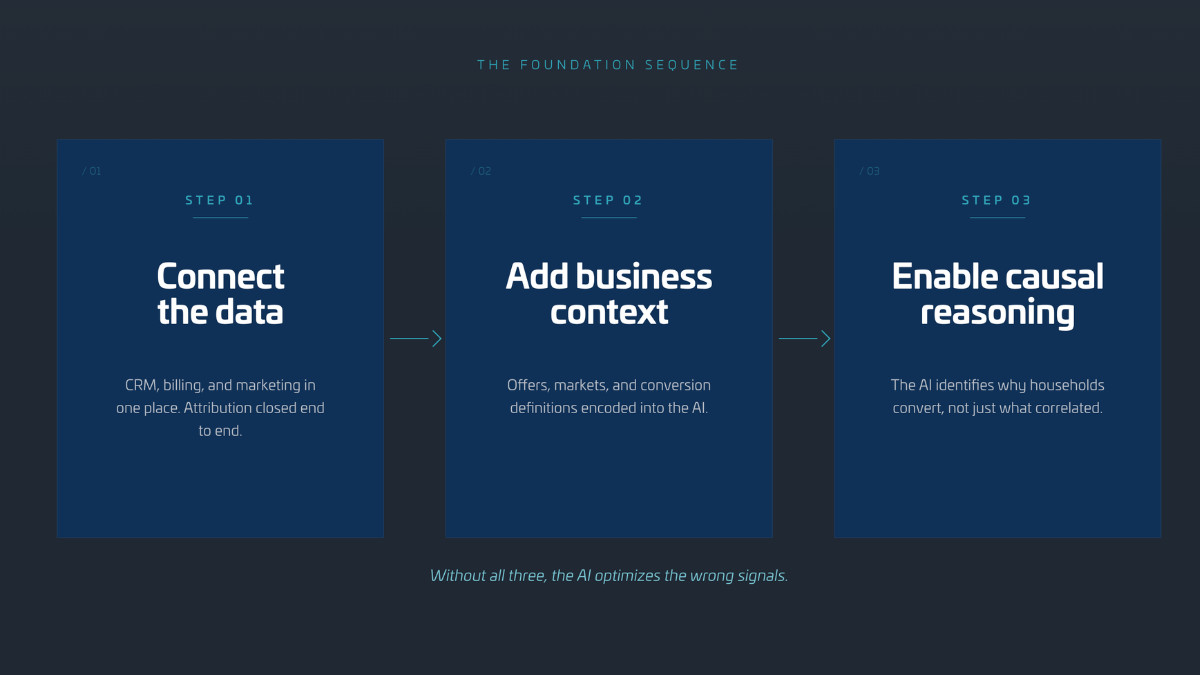
It’s not a one-off. It’s the pattern G2M sees consistently, and it always follows the same sequence.
The first step is connecting the data. CRM, billing, marketing, and network data need to be in one place, with a clear line from first marketing touchpoint to subscriber activation. Most operators already have this data. It’s sitting in separate systems that don’t talk to each other.
The second step is giving the AI business context. Clean data alone isn’t enough. The AI needs to understand your specific market: the provides you run, how your footprint is structured, and what a conversion means for your business, not what it can infer from raw event data.
The third step is causal reasoning. This is what moves the number. It’s the difference between an AI that tells you what campaigns had the highest CTR last quarter and one that tells you why a specific household type converts on a specific offer in your market. One tells you what happened. The other tells you what to do.
With those three things in place, the AI you already have can do something it currently can’t: reason causally. Not what correlated with a past conversion, but why a specific household converts on a specific offer. That’s the distinction that moves acquisition economics.
You stop chasing impressions. You start targeting the households most likely to convert. Spend goes where the data says it should.
Based on G2M client benchmarks, operators who’ve built this foundation are seeing CAC reductions of 30–50%. These are regional operators, not technology companies with custom-built AI systems. They didn’t change the AI. They changed what the AI was reasoning from.
The question worth asking
Most operators are asking which AI to deploy next. The operators getting results are asking a different question: what foundation does our AI need underneath it to work?
The spend isn’t the problem. The stack isn’t the problem. The data infrastructure underneath the AI is. That’s the one variable you can control.
The AI you’ve invested in isn’t broken. It’s working on the wrong inputs. Fix that, and the tools you already have start producing the results you were expecting.
On May 27th at 1:30 PM ET, Pierre Elisseeff will walk through exactly what that looks like in practice: how operators have built the foundation, what closing the loop from campaign to subscriber looks like, and what it’s done to their acquisition economics. Register to see how operators are cutting CAC with the AI they already have.