
Trusted Revenue Assessment Results
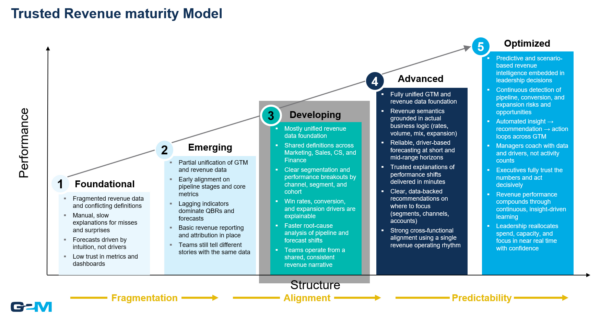
Stage 3: Developing
Based on your responses, your organization scored in the Developing tier of the Trusted Revenue Maturity Model. This indicates that core revenue foundations are largely in place, and performance is becoming explainable rather than reactive. At this stage, GTM and revenue data are mostly unified, definitions are increasingly consistent, and leaders can explain performance shifts with data instead of opinion. While revenue is not yet fully predictable, the organization has crossed a critical threshold: alignment is improving, and decisions are increasingly grounded in a shared revenue narrative.
Where You Stand Today
Your responses indicate that your organization is in the Developing stage of Trusted Revenue maturity. This means revenue outcomes are no longer mysterious. Leaders and managers can usually explain why pipeline, conversion, or expansion changed, and which drivers mattered most.
Typical questions at this stage sound like:
-
-
Which segments or channels actually drove the shift?
-
Was this change driven by rate, volume, or mix?
-
What should we adjust to influence the next outcome?
-
These questions are now answerable but not always fast enough or consistently enough to stay ahead of the business.
What This Means for Your Organization
In the Developing stage, revenue becomes explainable, but not yet fully predictable. Most organizations at this stage experience:
-
-
A mostly unified revenue data foundation
-
Shared definitions across Marketing, Sales, CS, and Finance
-
Clear segmentation and performance breakouts
-
Faster root-cause analysis of pipeline and forecast shifts
-
A growing sense of alignment across teams
-
However, explanations still require some manual effort, and proactive insights are emerging but not yet systematic.
Common Indicators at This Stage
Organizations operating in the Developing stage typically experience:
-
-
Mostly Unified Revenue Data: GTM and revenue data are consolidated, with only minor reconciliation gaps.
-
Consistent Definitions: Core metrics and pipeline stages are aligned across functions and used consistently in reviews.
-
Explainable Performance Shifts: Win rates, conversion, and expansion drivers can be identified and discussed with confidence.
-
Faster Root-Cause Analysis: Teams can diagnose issues in hours or days instead of weeks.
-
Shared Revenue Narrative: Cross-functional teams review performance using the same story even if actions still vary.
-
Your Priority: Move from Explainability to Predictability
The transition from Developing to Advanced is about operationalizing insight. To progress, organizations must:
-
-
Encode revenue logic (rates, volume, mix, expansion) into how performance is analyzed
-
Shift from reactive explanations to proactive signal detection
-
Improve forecast reliability at short- and mid-range horizons
-
Establish a consistent revenue operating rhythm for decision-making
-
This is where revenue shifts from being understood to being actively managed.
Recommended Next Step
If you’d like clarity on what to prioritize and how to move forward, we can guide you through a structured readiness review.

In this short working session, we’ll assess your current revenue operating model, identify the biggest alignment gaps, and outline a practical path toward explainable, predictable revenue.
Looking Ahead
With reliable driver-based forecasting and a consistent revenue operating rhythm in place, your organization will be ready to enter the Advanced stage, where revenue becomes predictable, aligned, and decisively managed across the enterprise.