
Trusted Revenue Assessment Results
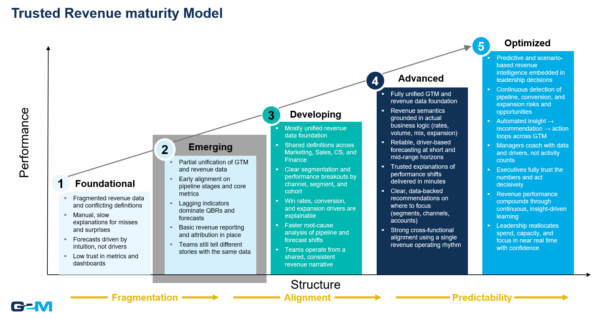
Stage 2: Emerging
Based on your responses, your organization scored in the Emerging tier of the Trusted Revenue Maturity Model. This indicates that foundational work is underway, but revenue is not yet operating as a consistently aligned or predictable system. At this stage, key GTM and revenue data sources are beginning to come together, and teams are making progress toward shared definitions. However, alignment is still fragile. Under pressure teams often revert to manual reconciliation, lagging indicators, and competing explanations.
Where You Stand Today
Your responses indicate that your organization is in the Emerging stage of Trusted Revenue maturity. This means you’ve moved beyond pure fragmentation. Some structure exists, and leaders can access more data than before. But revenue outcomes are still difficult to explain quickly and confidently.
Common challenges at this stage include questions like:
-
-
Why did the forecast change again in the final weeks?
-
Which teams or channels are actually driving the variance?
-
Why do different functions still tell different revenue stories?
-
While reporting has improved, insight and alignment lag behind. Decisions are informed but not yet trusted.
What This Means for Your Organization
In the Emerging stage, revenue is measured, but not yet managed as a system. Typically:
-
-
Data is partially unified, but not reconciled end-to-end
-
Pipeline stages and metrics are defined but inconsistently enforced
-
Forecasts rely heavily on lagging indicators
-
Explanations arrive late, after the window to act has passed
-
Alignment depends on meetings, not shared truth
-
This creates a dangerous middle ground: leaders feel closer to clarity, but still lack confidence when it matters most.
Common Indicators at This Stage
Organizations operating at the Emerging stage often experience:
-
-
Partial Data Unification: Core GTM and revenue systems are connected, but discrepancies remain unresolved.
-
Early Definition Alignment: Pipeline stages and KPIs are documented, but not consistently applied across teams.
-
Lagging Visibility: QBRs and forecasts focus on what already happened, not what’s likely to happen next.
-
Improved Reporting, Limited Insight: Dashboards are cleaner, but still require interpretation and debate.
-
Conditional Trust: Leaders trust the numbers most of the time—until pressure exposes gaps.
-
Your Priority: Make Alignment Durable
Progressing beyond the Emerging stage requires moving from partial alignment to durable alignment. The focus at this stage should be on:
-
-
Enforcing shared definitions across Marketing, Sales, CS, and Finance
-
Reconciling revenue data into a single, trusted narrative
-
Shifting from lagging metrics to driver-based explanations
-
Reducing dependency on manual analysis and meetings for clarity
-
This is where revenue begins to transition from reporting to explainability.
Recommended Next Step
If you’d like clarity on what to prioritize and how to move forward, we can guide you through a structured readiness review.

In this short working session, we’ll assess your current revenue operating model, identify the biggest alignment gaps, and outline a practical path toward explainable, predictable revenue.
Looking Ahead
With consistent definitions and a unified revenue foundation in place, your organization will be ready to move into the Developing stage, where revenue shifts become explainable, alignment improves across teams, and leaders can confidently answer why performance is changing.