




G2M Trusted AI Self Assessment
Stage 3: Developing
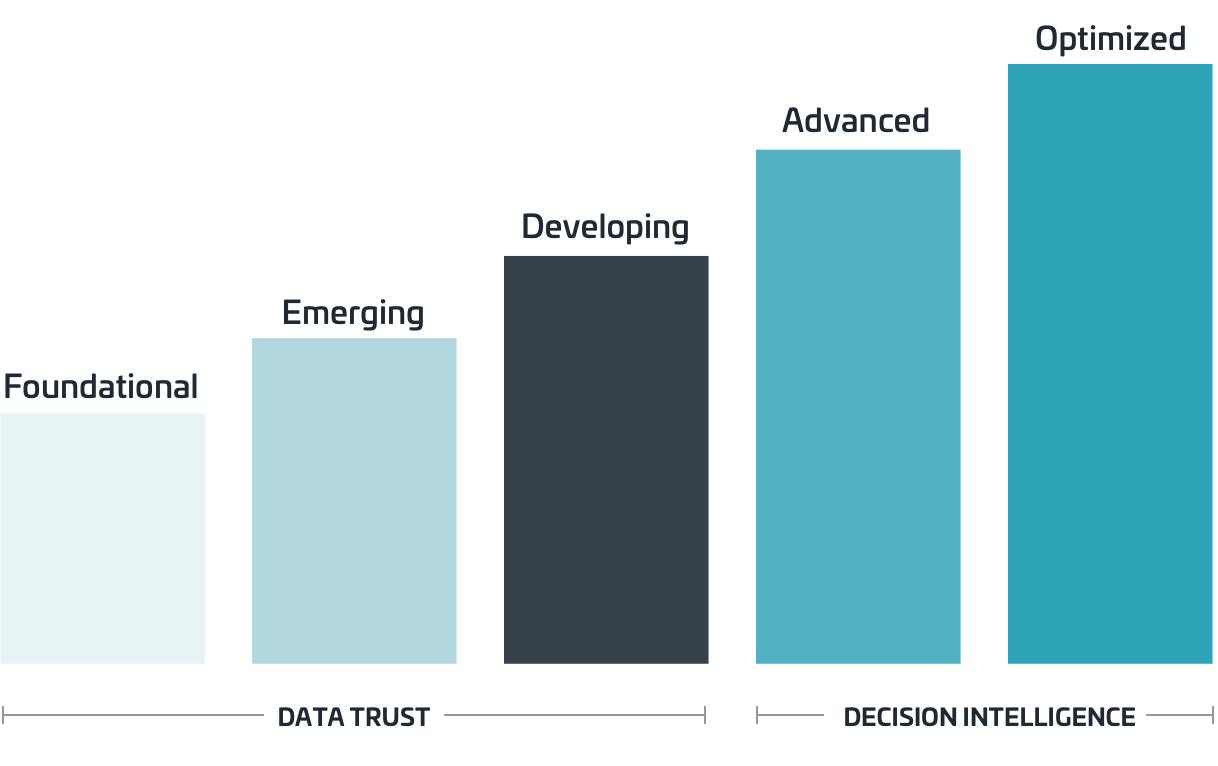
Based on your responses, your organization scored in the Developing tier of our Trusted AI Maturity Model, indicating that you’ve moved beyond early alignment and now operate on a mostly unified data foundation with clearer, more consistent definitions. AI outputs are becoming more reliable and explanations are faster and more grounded. Still, some insights require manual interpretation and narrative alignment can drift, signaling the need for stronger semantics, deeper business logic, and more mature causal reasoning to fully support decision-ready intelligence.
Where You Stand Today
Based on your responses, your organization scored in the Developing tier of our Trusted AI Maturity Model. This indicates that you have moved past foundational fixes and early alignment work: your data is mostly unified, definitions are clearer, and AI is beginning to deliver more reliable, grounded insights. Many of the structural elements required for Trusted AI are now in place, allowing your teams to diagnose performance with greater confidence and surface insights earlier in the cycle.
However, while the fundamentals are stabilizing, the system is not yet mature enough to generate fully automated, consistent explanations or proactive recommendations. Some insights still require human interpretation, and cross-functional narratives may diverge at times. To reach true decision intelligence, you’ll need to deepen semantic consistency, strengthen causal reasoning, and ensure AI is fully aligned with your business logic.
What This Means for Your Organization
Organizations at the Developing stage have achieved a meaningful shift:
-
Data is largely unified and consistent across GTM functions
-
Definitions are mostly shared, reducing weekly debates over “whose number is right”
-
AI outputs are more reliable, grounded in the organization’s actual metrics and structure
-
Leaders can often answer why performance changed, not just what changed
-
Insight surfacing is faster, less manual, and more accurate
Yet the journey is not complete. While reactive analysis is improving, proactive insight still lags. AI can support explanations, but may struggle with nuance, complex segmentation, or emerging trends without human validation. Teams are aligned more often, but narrative drift can still appear during major reviews.
This is the stage where organizations shift from solving for clarity to enabling decision velocity.
Common Indicators at This Stage
Teams operating at the Developing level typically experience:
-
Mostly Unified Data Foundation. Core GTM systems are reconciled, with fewer gaps or manual stitching required.
-
Shared, Clearer Definitions. Most teams use the same metric logic, and semantic updates propagate more consistently.
-
Grounded AI Improving Reliability. AI outputs increasingly reflect your true business model, not generic assumptions.
-
Granular Performance Breakouts. Leaders can drill into segments, cohorts, channels, or regions to understand specific drivers.
-
Better Cross-Functional Narrative Alignment. Sales, Marketing, Finance, and Ops are closer to sharing a unified understanding of performance.
-
Early Proactive Insight Surfacing. Some anomalies and performance changes are detected before they fully materialize.
-
Faster Root-Cause Identification. Explanations rely less on manual detective work and more on structured decomposition.
Your Priority: Strengthen Semantics and Causal Intelligence
To progress into the Advanced stage, your next focus is on building the systems and governance needed for AI to produce consistent, causal, and fully explainable insights at scale. That includes:
-
Deepening your semantic layer and ensuring metrics never drift
-
Encoding more of your business logic into the data foundation
-
Improving causal decomposition (rate/volume/mix) across every KPI
-
Standardizing insight narratives across GTM teams
-
Reducing the remaining friction in cross-functional interpretation
-
Expanding AI’s ability to surface proactive recommendations
With these steps, your AI can shift from supporting analysis to accelerating decisions, the hallmark of Stage 4 maturity.
Recommended Next Step
If you want guidance on how to evolve from insight clarity to true decision intelligence, we can support you with a structured GTM readiness review.
Contact us to set up a working session
In this working session, we’ll assess your current semantic layer, review the reliability of your insight surfacing, and outline the steps required to scale grounded, causal AI across the organization.
Looking Ahead
With deeper semantics, refined business logic, and consistent cross-functional alignment, your organization will be ready for the Advanced stage, where Trusted AI delivers mature, causal explanations, proactive recommendations, and rapid decision velocity across teams.