






Slop grenade.
You have likely had one of these land in your inbox recently.
Shopify CEO Tobi Lütke recently used the term on The Knowledge Project podcast in September, when he was asked whether AI had made anything worse at Shopify. “We call those ‘slop grenades’ that people toss at each other,” he said.
Someone has an AI agent write a code change, approves it without reading it closely, and leaves colleagues to review it.
The sender saves a few minutes, but the team pays for it in rework and poorly thought-through decisions.
And if AI is making people lazy at one of the most AI-forward companies there is, it’s making your team lazy too.
The Risk of Cognitive Offloading: handing off the thinking
Most teams have adopted AI. The issue lies in how much of what it generates they accept without reviewing it again. Researchers refer to delegating tasks to a tool as cognitive offloading, which becomes problematic when the judgment is also outsourced, as shown here:
- No original thought going in
- No critique of what comes out
- No challenge to the first answer
- Straight to the next person
It’s easy to see how it happens.
Executives want to hear the AI plan, so speed gets rewarded, and review gets skipped. The mandates tell people to use AI, but often don’t tell them how.
The importance of analytical thinking
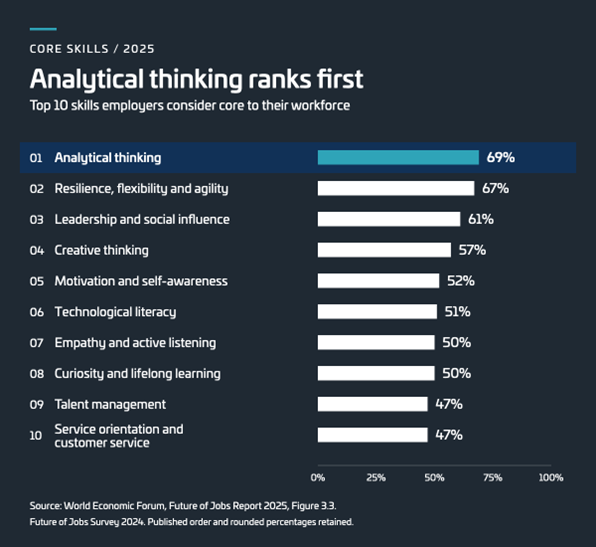
The cost is higher than a bad email. Analytical thinking and problem-solving are what separate the teams that win from the teams that don’t.
In the World Economic Forum’s 2025 Future of Jobs survey, employers rank analytical thinking first: nearly 70% named it a core skill more than any other skill.
Offloading thinking trades exactly that skill for speed.
Where slop shows up in your company
The obvious slop grenades are easy to spot:
- An intern pastes an answer straight from chat.
- An email lands that’s three times longer and more formal than it needs to be.
- A meeting summary repeats everything that was said and never says what was decided.
The dangerous grenade looks like a polished deck. An analysis or a recommendation that reads well, is confidently structured, but is wrong. When skimmed, it passes.
Then it reaches leadership, and someone challenges a slide:
Why did margin drop in the Southeast?
The presenter looks at the slide. The slide doesn’t say. Nobody on the team built that number, so no one can explain it, and no one noticed it was wrong. The room goes quiet, and everyone is now wondering what else in the deck nobody checked.
Even your highly skilled teams are vulnerable
Researchers from Harvard, MIT, and Wharton tested this with 758 consultants at Boston Consulting Group. Some worked with GPT-4. Some didn’t. On tasks AI is good at, the consultants using it were faster and did better work. Then came a business problem AI is bad at, one that meant checking the numbers against what managers had said in interviews. This time, the consultants using AI were 19 percentage points less likely to get the right answer. The AI’s answer sounded convincing, and many of them went with it.
That’s the polished-but-wrong deck in a controlled experiment: judgment lost on the day, at one of the best-staffed firms in the world.
The longer people lean on an AI tool, the more their own expertise can fade.
In a 2025 study in The Lancet Gastroenterology & Hepatology, experienced endoscopists, each with more than 2,000 procedures behind them, found precancerous growths in 28.4% of colonoscopies on their own. Then their clinics brought in AI to help spot growths. After months of using it routinely, their rate on colonoscopies done without it fell to 22.4%.
Engineers call it the ironies of automation: the more a system handles the routine, the less practice people get for the rare, hard moment. In 2009, iced-over sensors on Air France Flight 447 made the autopilot hand control back to a crew out of practice flying by hand. Four and a half minutes later, the plane was in the Atlantic.
The output looks better. The people get weaker.
Solution: Hand off the tasks, keep the thinking
Nobody misses computing square roots by hand. Calculators took over arithmetic and freed people for harder problems. AI is doing the same for summaries, first drafts of routine documents, research legwork, and formatting.
Handing off tasks is how you get that time back. Handing off the thinking is how you lose the skill. Strategy, recommendations, the reasoning behind a number, anything you’ll have to defend in the room: that stays with your people, because that’s where the skill lives.
The difference is in the workflow design
There are two ways to use these AI tools. You can say do this for me and paste in whatever comes back. Or you can argue with it, push back on what it gets wrong, and stay in the work the whole way through. The first erodes the skill. The second sharpens it, because the skill gets used.
Which way a team goes shouldn’t be left to willpower. It’s set by how the work is designed, and early research, mostly in classrooms, suggests design works.
Five rules a leader can set to keep a team sharp
These five rules make sure your people still do the thinking while AI does the testing.
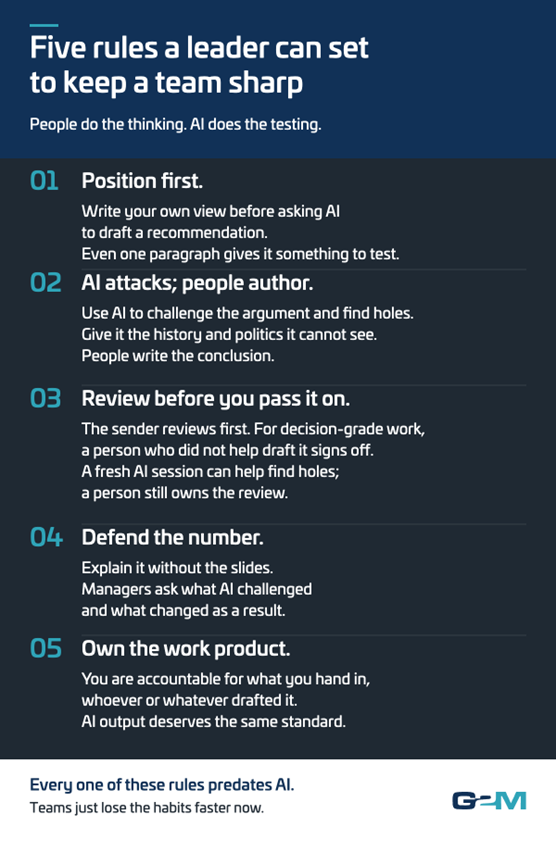
- Position first. No AI draft of a recommendation until its owner has written their own view, even if it’s one paragraph. Then the AI has something to react to.
- AI attacks; people author. On judgment work, use AI to challenge the argument from different angles and look for holes. People write the conclusion. Give the AI the context it can’t see, like the history and the politics.
- Review before you pass it on. The sender reviews first, so the review never gets pushed downstream. Decision-grade work then gets a second set of eyes. A fresh AI session can help find the holes, but a person who had no hand in the draft signs off. Professional services have always had one person prepare and another review. At AI speed, it matters more. Yes, it takes time. It costs far less than a number nobody can defend.
- Defend the number. Whoever presents it can explain it without the slides. Managers ask what the AI pushed back on, and what changed as a result.
- Own the work product. People are accountable for what they hand in, no matter who or what drafted it. If someone brought you unreviewed work from five summer interns, you’d send it back. AI output deserves the same standard.
Every one of these rules predates AI. Teams just lose the habits faster now.
People take responsibility for outcomes
Lütke’s fix for slop grenades is simple: “machines can’t take responsibility for work and people do.”
The organizations that lead the next decade won’t be the ones that offload the most. They’ll be the ones whose people got sharper as the tools got better.
A decision built with AI is only as defensible as the person who can explain it. That’s the idea behind what we call Trusted AI: the reasoning stays visible, so a person can question it and stand behind it.
When we rebuilt our own delivery around AI, we kept people reviewing the work at every stage before anything reaches a client. The AI moves fast. People decide what ships.
Used that way, AI makes the board meeting easier. When we use AI as a sparring partner and make it question a strategy from every angle, it shows us things we wouldn’t have seen on our own. By the time we walk into the room, we’ve already worked through what could go right, what could go wrong, and what nobody has raised yet.
That’s what prepared feels like.
Sources and further reading
- Tobi Lütke on “slop grenades,” The Knowledge Project podcast, September 2026 (coverage in Search Engine Journal)
- Tobi Lütke, “Reflexive AI usage is now a baseline expectation at Shopify”, internal memo shared on X, April 2025
- World Economic Forum, The Future of Jobs Report 2025
- Dell’Acqua et al., “Navigating the Jagged Technological Frontier: Field Experimental Evidence of the Effects of AI on Knowledge Worker Productivity and Quality”, Harvard Business School
- Romańczyk et al., “Endoscopist deskilling risk after exposure to artificial intelligence in colonoscopy”, The Lancet Gastroenterology & Hepatology, 2025
- Lisanne Bainbridge, “Ironies of Automation”, Automatica, 1983
- “Air France Flight 447 Crash Caused by a Combination of Factors”, IEEE Spectrum, on the French investigators’ final report
- Bastani et al., “Generative AI without guardrails can harm learning: Evidence from high school mathematics”, PNAS, 2025
- Contractor and Reyes, “Experimental Evidence on the Learning Impact of Generative AI”, 2026
